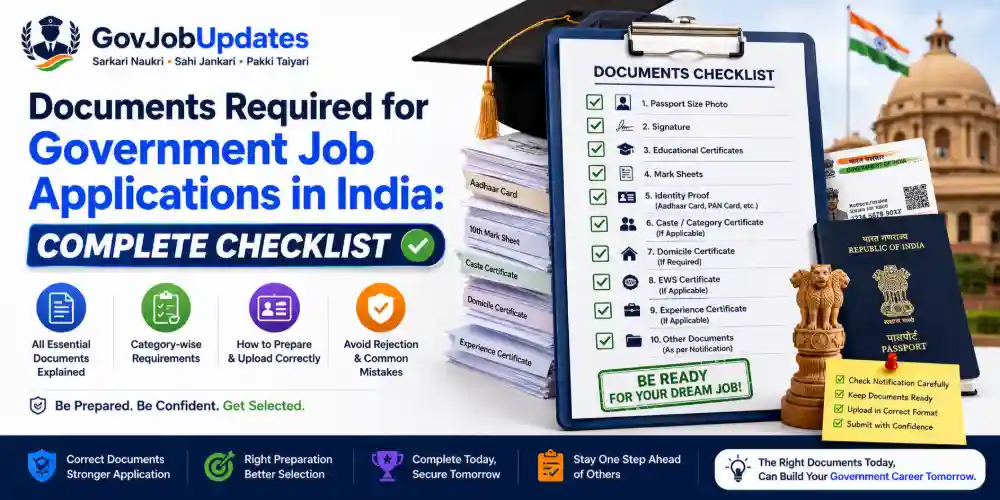
1. Why Document Preparation Deserves as Much Attention as Studying
It is a genuinely painful experience to clear a written exam, do well in an interview or physical test, and then face rejection or serious complications purely because a document wasn't ready, had expired, or contained a small clerical mismatch. Unlike exam performance, document preparation is entirely within your control and doesn't depend on luck or competition — which makes it one of the highest-value, lowest-effort areas to get right early.
Many of the documents listed below take time to issue through government offices, and that processing time is often the bottleneck, not your own effort. Starting early, sometimes even before a specific notification is released, is the single best strategy here.
2. Identity and Personal Documents
- Aadhaar Card: Increasingly used as a primary identity and address proof across most application forms and verification processes. Ensure your name, date of birth, and address are correctly updated and match your other documents.
- PAN Card: Frequently required for salary account setup, fee payments, and identity verification. Ensure your name matches your other core documents exactly, including spelling.
- Passport (if available): Not mandatory for most domestic exams, but useful as an additional identity/address proof and essential for certain defence, paramilitary, or international-facing government roles.
- Voter ID Card: Sometimes accepted as an additional identity or age proof, particularly at the local or state level.
3. Educational Documents
- Class 10 (Secondary) Certificate and Mark Sheet: Almost universally required, primarily as proof of date of birth, since this is usually the earliest official record of your birth date.
- Class 12 (Senior Secondary) Certificate and Mark Sheet: Required for posts with a 12th-pass eligibility criterion, and often for subject-stream verification.
- Graduation/Post-Graduation Degree Certificate and Mark Sheets: Required for graduate-level and above posts. If your final degree certificate hasn't been issued yet by your university, a provisional certificate along with all semester/year mark sheets is usually accepted, though always confirm this against the specific notification's requirements.
- Diploma/ITI Certificates (if applicable): Required for technical posts with specific diploma or ITI-based eligibility.
- Migration Certificate: Sometimes required, especially when moving from one educational board or state to another for higher studies or employment purposes.
- School Leaving/Transfer Certificate: Occasionally required as supporting proof alongside your Class 10 or 12 certificate.
4. Category and Reservation Certificates
These certificates are among the most time-sensitive and easy to overlook until the last moment, so pay particular attention to this section:
- SC/ST Certificate: Issued by a designated competent authority (typically the Tehsildar, SDM, or a similarly authorised revenue officer), confirming your caste status as per the central or state list, depending on the recruiting body's requirements.
- OBC-NCL (Non-Creamy Layer) Certificate: This certificate typically has a limited validity period (often around one year from issue, though this varies), so it frequently needs to be renewed close to the application or verification date rather than relying on an older copy.
- EWS (Economically Weaker Section) Certificate: Issued based on income and asset criteria defined by the government, and similarly time-sensitive, usually needing to be current within a specified period before use.
- PwBD (Persons with Benchmark Disability) Certificate: Issued by an authorised medical board as per the specific disability category and percentage criteria defined for the post, sometimes requiring a specific format prescribed by the recruiting body.
- Ex-Servicemen Certificate: Issued through the relevant defence authority, required for candidates applying under the ex-servicemen reservation category.
Since certificate issuance can take anywhere from a few days to several weeks depending on your local administrative office's workload, it is genuinely worth applying for or renewing these certificates proactively, rather than waiting until a specific notification with a tight deadline appears.
5. Domicile and Residence Documents
- Domicile/State Residence Certificate: Required for state-specific quotas or state government exams that reserve seats or relax criteria for residents of that particular state.
- Local/Regional Candidate Certificate: Some states or specific recruitment drives require proof of residence within a particular district or region for local quota benefits.
6. Photographs and Signature Specifications
Almost every online application requires a recent passport-size photograph and a scanned signature, usually with specific technical requirements — exact pixel dimensions, file size limits (commonly under a certain number of kilobytes), and file format (typically JPEG). Many candidates lose valuable time during a tight application window simply because their scanned photo or signature doesn't meet the exact specifications listed in the notification.
It's a good practice to keep a properly formatted, recent photograph and signature scan ready in advance, in a few common size variants, so you're never scrambling to resize or rescan an image close to a deadline.
7. Documents Specific to Certain Posts
- Medical Fitness Certificate: Required for physically demanding roles such as police, defence, and certain technical posts, usually issued after a medical examination conducted by an authorised government medical officer at a later stage.
- Character Certificate: Sometimes required from a school/college principal or a gazetted officer, confirming good conduct.
- NOC (No Objection Certificate) from Current Employer: Required if you are already employed in a government or certain private organisations and are applying for a new government post, confirming your current employer has no objection to you applying or later joining.
- Sports/Extra-Curricular Certificates: Relevant only for specific posts or quotas that consider sports achievements or extra-curricular credentials as part of eligibility or additional weightage.
8. Bank and Financial Documents
- Bank Account Details: Required for fee payment (if paying via challan/offline mode) and, later, for salary account setup once selected.
- Income Certificate: Required specifically for EWS category applications, and occasionally for certain scholarship or fee-concession related purposes during the application process.
9. How to Organise Your Documents Practically
Rather than scrambling to locate documents individually every time a new notification appears, consider maintaining a dedicated physical folder and a digital folder (cloud storage) containing:
- Scanned copies of every document listed above, properly labelled by document type
- At least four to five self-attested photocopies of your most frequently required documents (Aadhaar, PAN, educational certificates, category certificate)
- A properly formatted photograph and signature scan, saved in a few common size specifications
- A simple spreadsheet or note tracking each certificate's issue date and expiry (if applicable), so you know well in advance when a renewal will be needed
This kind of preparation, done once, saves enormous stress and time across every single application you make over the following months or years.
10. Common Document-Related Mistakes to Avoid
- Name mismatches across documents: Even small spelling differences between your Aadhaar, PAN, and educational certificates can cause complications during verification. If you notice a mismatch, get it corrected well in advance through the respective issuing authority.
- Using an expired category certificate: Particularly common with OBC-NCL certificates, which have limited validity and are easy to forget about until verification day.
- Carrying only photocopies to verification, without originals: Verification almost always requires original documents to be physically shown alongside submitted photocopies.
- Incorrectly formatted photo/signature uploads: A frequent, avoidable cause of application delays or errors during the online submission process.
- Waiting until the last week to arrange a category or domicile certificate: Given genuine administrative processing time, this is one of the most common causes of missed deadlines that has nothing to do with exam preparation at all.
Frequently Asked Questions (FAQs)
How early should I start preparing documents for a government job application?
Ideally, well before you even see a specific notification. Category certificates, income certificates, and domicile certificates can take anywhere from a few days to several weeks to be issued depending on your state and local administrative office, so keeping these ready in advance saves enormous stress when a notification with a tight deadline appears.
What happens if my category certificate has expired by the time of document verification?
Rules vary by recruiting body and category, but many certificates such as OBC-NCL (non-creamy layer) certificates have a limited validity period and may need to be renewed closer to the verification date. Check the specific notification's requirements regarding certificate validity, and if in doubt, get a fresh certificate issued closer to the verification date rather than risking rejection over an expired document.
Can I use a photocopy instead of the original document during verification?
No. Document verification for government jobs almost always requires original documents to be physically produced for checking, along with self-attested photocopies to submit. Carrying only photocopies without the originals is one of the most common and entirely avoidable reasons candidates face problems at the verification stage.
11. Digital Document Storage: A Habit Worth Building Long-Term
Beyond a single application, it's worth building a lasting habit of maintaining a well-organised digital archive of every important document you own, updated as certificates are renewed or new ones are issued. A simple, clearly labelled folder structure — separated into identity documents, educational documents, category certificates, and post-specific documents — makes future applications significantly faster, since you are never starting the search for a document from scratch.
Many candidates apply to multiple government exams over a period of months or years, and having this system already in place before your next opportunity appears is a genuine competitive advantage that has nothing to do with subject knowledge, yet consistently saves successful candidates from last-minute panic.
A note on this guide
This article provides a general, commonly applicable checklist of documents used across most government job applications in India. Exact document requirements, certificate formats, and validity periods vary by recruiting body, post, state, and category. Always refer to the specific official notification for the exam you're applying to, and confirm certificate requirements with the relevant issuing authority.
Discussion 0
Join the Discussion
Login to your account to share comments, tips, and engage with other aspirants.