
1. Ongoing Landmark Milestones of the 2026 Edition
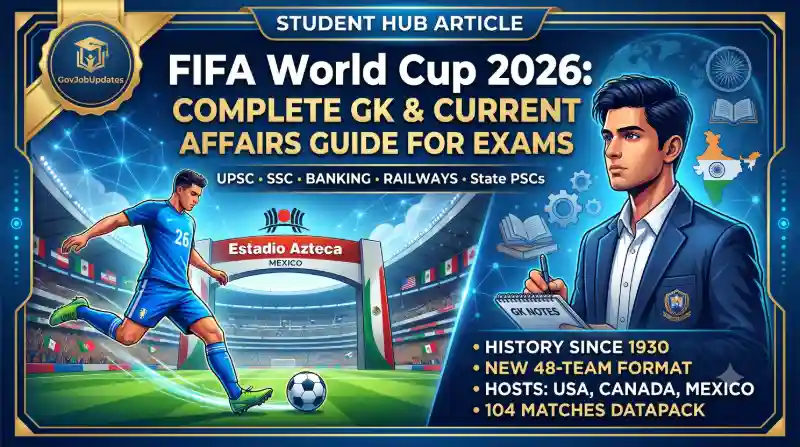
The 23rd edition of the FIFA World Cup kicked off with its monumental opening ceremony on June 11, 2026, at the iconic Estadio Azteca in Mexico City. Running through to July 19, 2026, this tournament marks the return to the traditional June–July summer schedule following the unique winter format seen in Qatar 2022.
Aspirants should note that the hotly anticipated final match is scheduled to take place at the MetLife Stadium in East Rutherford, New York New Jersey, introducing a Super Bowl-style halftime show to a FIFA World Cup final for the first time. The tripartite co-hosts—Canada, Mexico, and the United States—all received automatic qualification slots, distributing the massive fixture layout across 16 world-class sporting venues throughout the continent.
2. Explaining the Structural New Tournament Pattern
For examiners seeking conceptual questions on institutional changes, the 2026 format introduces the single biggest restructuring of the competition layout since 1998. The competition has formally expanded from a 32-team grid to an ambitious 48-nation framework, significantly elevating the aggregate match tally from 64 games to 104 matches.
Under this system, the 48 qualified countries were sorted into 12 distinct groups consisting of 4 teams each. The adjustment ensures that teams do not suffer the strategic collusion risks inherent in previously proposed 3-team group formats. The structural advancement pipeline works as follows:
- The top two teams from all 12 groups automatically advance into the knockout structure.
- They are joined by the 8 best third-placed finishers from across the groups.
- This initial consolidation funnels 32 processing teams directly into a newly added "Round of 32" elimination bracket.
- Due to this extra knockout phase, any nation advancing all the way to the final must navigate 8 total fixtures, an increase from the traditional 7 matches.
3. Chronological History of the FIFA World Cup
To secure marks in conventional static GK modules, students must trace the history of soccer's global governing body. Founded in 1904, FIFA (Fédération Internationale de Football Association) inaugurated the premier Men's World Cup tournament in 1930. The inaugural event was entirely hosted and won by Uruguay, who defeated Argentina in the historic final in Montevideo.
The tournament has recurred consistently every four years since its inception, experiencing only two cancellations in 1942 and 1946 due to the profound global disruption of World War II. Over its 96-year lineage, the tournament size has evolved dynamically—scaling from 13 teams in 1930, to 16 teams throughout most of the 20th century, reaching 24 teams in 1982, 32 teams in 1998, and finally settling on the current 48-team framework in 2026.
4. Global Leaders: The Most Successful Nations
Data analytics regarding past winners frequently populates match-the-following style queries in central examinations. Only 8 sovereign nations have managed to claim the ultimate trophy across the preceding 22 editions of the tournament:
Brazil (5 Titles): Officially the most successful footballing nation on Earth, achieving championship glory in 1958, 1962, 1970, 1994, and 2002. Brazil remains the only federation to have participated in every single edition without exception.
Germany and Italy (4 Titles Each): European football superpowers holding four stars apiece. Germany secured wins in 1954, 1974, 1990, and 2014, while Italy dominated in 1934, 1938, 1982, and 2006.
Argentina (3 Titles): The reigning champions who hoisted their third title at the Lusail Stadium during the historic Qatar 2022 edition, building on their previous victories in 1978 and 1986.
France and Uruguay (2 Titles Each): France took home the trophy in 1998 and 2018, matching Uruguay's early historic successes in 1930 and 1950.
England and Spain (1 Title Each): England clinched their solitary title on home soil in 1966, while Spain established a golden era to win their maiden crown in South Africa in 2010.
Frequently Asked Questions (FAQs)
Which countries are co-hosting the FIFA World Cup 2026?
The FIFA World Cup 2026 is jointly hosted by three North American countries: Canada, Mexico, and the United States. Matches are distributed across 16 designated host cities.
How many teams are participating in the FIFA World Cup 2026?
For the first time in tournament history, the competition expands from 32 teams to 48 teams, increasing the total number of matches to 104 played over a 39-day period.
Which country has won the most FIFA World Cup titles historically?
Brazil is the most successful nation in FIFA World Cup history, holding a record five championship titles (1958, 1962, 1970, 1994, and 2002).
Discussion 0
Join the Discussion
Login to your account to share comments, tips, and engage with other aspirants.