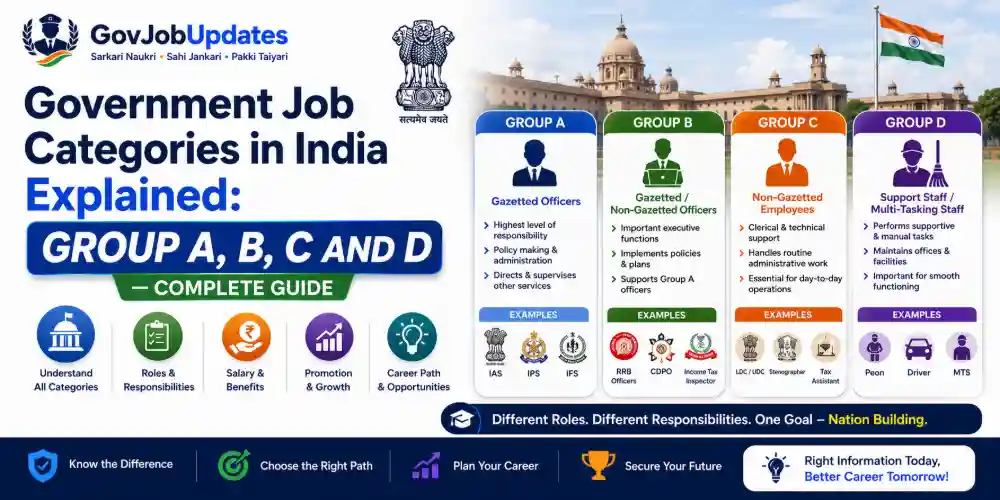
1. Why India Classifies Government Jobs Into Groups at All
India's civil service classification system dates back to the structure inherited and refined after independence, designed to organise the enormous machinery of government into clear layers of responsibility, authority, and accountability. Rather than treating every government employee identically, the system groups roles based on the nature of duties, the level of decision-making involved, and the qualifications typically required.
This classification affects far more than just a label on your appointment letter — it influences your pay level, your promotion path, whether you're classified as "gazetted" or "non-gazetted," and in many cases, the kind of authority you can exercise in your role. Understanding this system early can help you set realistic expectations and choose exams that align with your actual career goals.
2. Group A: The Senior-Most Administrative and Technical Tier
Group A represents the highest tier of government service, encompassing the senior-most administrative, technical, and specialised roles across ministries, departments, and public sector functions. This includes some of India's most well-known and competitive services — the Indian Administrative Service (IAS), Indian Police Service (IPS), Indian Foreign Service (IFS), and a wide range of other Central Civil Services, along with senior technical roles in engineering, medical, and scientific departments.
Group A officers typically hold significant decision-making authority, often supervising large teams, managing substantial budgets, and playing a direct role in policy implementation or, in senior positions, policy formulation itself. Entry into most Group A civil services happens through highly competitive national-level examinations, most famously the UPSC Civil Services Examination, though several technical Group A roles are filled through specialised recruitment processes specific to that field (such as engineering services or medical entrance routes).
Because of the scale of responsibility, Group A positions are almost universally "gazetted" — meaning the appointment and any subsequent transfers or promotions are formally published in the Gazette of India, a mark of the position's official significance.
3. Group B: The Crucial Middle Layer of Administration
Group B roles sit between the senior Group A tier and the larger operational Group C workforce, forming a crucial middle management layer. This group is itself often split into two sub-categories: Gazetted Group B and Non-Gazetted Group B, depending on the specific role and department.
Common Group B roles include section officers in various ministries, several state-level administrative and police services (such as certain State Civil Service and State Police Service positions filled through state public service commissions), and various supervisory or specialised technical roles across departments. Group B employees typically manage day-to-day operational execution, supervise Group C staff, and serve as the crucial link between senior policy-level decisions and ground-level implementation.
Many well-known state-level exams, along with several central recruitment exams such as certain categories within SSC's Combined Graduate Level examination, lead into Group B (and sometimes Group A, depending on the specific post) positions, making this an important and often less discussed target for serious aspirants.
4. Group C: The Backbone of Government Functioning
Group C is by far the largest category of government employment in India, encompassing the operational, clerical, and frontline workforce that keeps government departments, railways, banks, defence support units, and public sector organisations running on a daily basis. This includes roles such as clerks, assistants, stenographers, constables, technicians, ticket examiners, postal assistants, and a vast range of similar operational positions.
Group C is almost always Non-Gazetted, and recruitment typically happens through large-scale national and state-level competitive examinations conducted by bodies such as the Staff Selection Commission (SSC), Railway Recruitment Boards (RRB), Institute of Banking Personnel Selection (IBPS), various State Public Service Commissions, and numerous department-specific recruitment boards.
Because Group C recruitment happens at massive scale — often for tens of thousands of vacancies at once — these exams tend to have the widest reach among aspirants and represent the most common entry point into government service for candidates across educational backgrounds, from Class 10 pass eligibility up to graduate-level requirements depending on the specific post.
5. Group D: The Category That's Being Phased Out
Group D historically referred to the lowest tier of government employment, covering roles such as peons, helpers, sweepers, and other support-function positions requiring minimal formal educational qualifications, often around Class 8 or Class 10 pass level.
It's important for aspirants to know that over the past decade, the Government of India has been progressively merging most Group D posts into Group C, following recommendations aimed at simplifying the overall classification structure and improving pay parity for support staff. As a result, many positions that would historically have been labelled Group D are now officially classified under Group C in central government recruitment, though some states and specific departments may still use Group D terminology in their own service rules. Always check the specific classification mentioned in the official notification for the exact post you're applying for, rather than assuming based on the general historical structure.
6. Gazetted vs Non-Gazetted: A Related but Separate Distinction
A common point of confusion is the difference between "Group" classification and "Gazetted / Non-Gazetted" status — these are related but not identical concepts. A Gazetted Officer is someone whose appointment, promotion, or transfer is formally announced in the official Gazette of India (or state gazette), and who typically has the authority to attest documents, issue certain certificates, and exercise specific administrative powers.
Broadly, most Group A positions are Gazetted, Group B positions may be either Gazetted or Non-Gazetted depending on the specific role, and Group C positions are almost universally Non-Gazetted. This distinction matters practically — for example, many official processes require attestation by a Gazetted Officer, which is one of the real-world privileges that comes with reaching that status.
7. How Pay Levels Differ Across Groups
Government pay in India is structured through Pay Matrix Levels as recommended by successive Pay Commissions, and these levels broadly correlate with group classification, though there is meaningful overlap at the boundaries. Group A positions generally start at higher pay levels reflecting the seniority and responsibility of entry-level Group A roles compared to Group C entry-level roles.
Beyond basic pay, government employment across all groups typically includes a range of allowances (dearness allowance, house rent allowance, and others depending on posting location) and long-term benefits such as pension schemes, which have themselves evolved over time (from the older pension system to the National Pension System, and more recently the Unified Pension Scheme option introduced for central government employees). Because these structures are revised periodically by government decisions, always verify current pay levels and benefits from official sources rather than relying on older or unofficial figures.
8. How to Think About Which Group Fits Your Goals
Rather than assuming "higher group is always better," it's worth thinking honestly about what you personally value in a career. If long-term policy influence, national-level responsibility, and the most intense competitive preparation genuinely excite you, Group A services through exams like UPSC Civil Services may be worth the multi-year commitment they typically require.
If you value strong job security, meaningful public service, reasonable work-life balance, and a faster, more accessible entry point, Group B and Group C roles offer excellent, respected career paths without requiring the same years-long preparation timeline that top Group A exams often demand. Neither path is inherently superior — they simply suit different priorities, risk tolerances, and life circumstances.
9. Career Growth: Movement Between Groups
The classification system is not entirely rigid. Many government employees who join in Group C or Group B roles can progress over their careers through a combination of regular promotions, departmental competitive examinations, and, in some cadres, specific limited departmental competitive exams designed to allow experienced employees to move into higher groups.
This path varies considerably by department, state, and specific service rules, so if long-term upward mobility is important to you, it's worth researching the specific promotion and departmental exam structure of any organisation before applying, rather than assuming a single universal path applies across all of government service.
10. A Quick Reference Summary
- Group A: Senior administrative/technical roles, highest authority and responsibility, almost always Gazetted, entry typically via national-level competitive exams (e.g., UPSC Civil Services and specialised technical services).
- Group B: Middle-management operational and supervisory roles, may be Gazetted or Non-Gazetted, entry via central/state exams such as SSC CGL (for certain posts) and various State PSC exams.
- Group C: The largest operational and clerical workforce, almost always Non-Gazetted, entry via large-scale exams conducted by SSC, RRB, IBPS, State PSCs, and department-specific boards.
- Group D: Historically support-function roles with minimal formal qualification requirements; largely merged into Group C in central government structure over recent years, though terminology may still appear in some state/department rules.
Frequently Asked Questions (FAQs)
Which is better, Group A or Group B government job?
Group A positions generally carry higher authority, higher pay levels, and greater policy-making responsibility than Group B, since they are typically the senior-most operational and administrative roles. However, "better" also depends on your own priorities — some Group B roles offer excellent work-life balance, strong job security, and meaningful public service without the intense competition and pressure that often comes with top Group A exams.
Is Group C a bad career choice compared to Group A or B?
Not at all. Group C forms the backbone of government functioning and includes a huge range of stable, respected roles across departments, railways, banking, and defence support functions. Many Group C roles offer strong job security, steady growth through promotions, and a genuinely fulfilling career, especially for candidates who value stability over the intense long-term competition of top Group A exams.
Can a Group C or Group B employee later become a Group A officer?
In many departments, yes — through internal promotions, departmental exams, or specific limited departmental competitive examinations that allow serving Group B and C employees to move up over the course of their career. The exact path varies significantly by department and cadre, so it's worth checking the specific service rules of your organisation rather than assuming a single universal rule applies.
A note on this guide
This article explains the general structure of India's government job classification system. Specific pay levels, gazetted status, and group classification can vary by department, state, and post, and are periodically revised through official government decisions. Always verify the exact classification, pay level, and service rules mentioned in the official notification for any specific post before applying.
Discussion 0
Join the Discussion
Login to your account to share comments, tips, and engage with other aspirants.