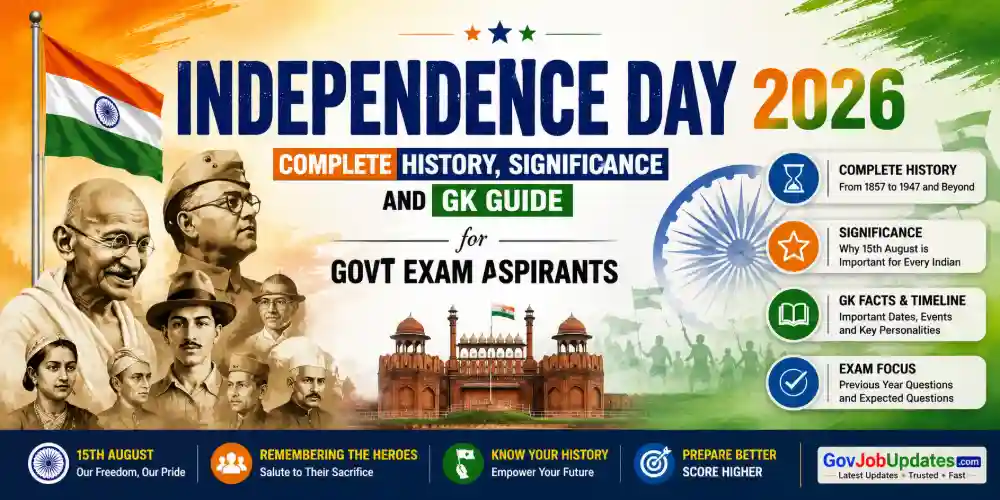
1. Why Independence Day 2026 Matters for Exam Aspirants
Every year around 15 August, competitive exams see a spike in questions related to India's freedom struggle, national symbols and the Constitution. This is not a coincidence — exam-setters use the occasion to test whether candidates understand not just dates, but the reasoning behind India's national identity. If you are preparing for SSC CGL, SSC GD, UP Police, Railway or any state-level PCS exam scheduled around this period, expect at least one or two questions built directly around Independence Day facts, freedom fighters, or the Constitution's founding principles.
Beyond exams, many government departments and platforms like MyGov and MyBharat run essay, quiz and painting competitions tied to Independence Day, some of which carry cash prizes and even an invitation to witness the Red Fort ceremony in person. Staying updated on these details also helps candidates preparing for interview rounds, where current-affairs awareness is often tested.
2. 79th Anniversary, 80th Independence Day: Clearing the Confusion
This is one of the most commonly misunderstood facts, and examiners know it. India became independent on 15 August 1947. That very day was counted as the country's first Independence Day. So when we count forward, 15 August 2026 completes 79 full years since independence — meaning 2026 marks the 79th anniversary of independence. But since 1947 itself was "Independence Day number one," the day being observed in 2026 is officially referred to by many government and media sources as the 80th Independence Day.
Both figures are technically correct depending on how the question is framed — "years since independence" versus "which Independence Day is this." Candidates should not be caught off guard by either number in an exam and should always double-check the exact phrasing used by the Press Information Bureau (PIB) or the Ministry of Culture closer to the exam date.
3. The Long Road to Freedom: A Quick Timeline of India's Struggle
Independence Day cannot be understood in isolation — it was the result of a movement that spanned nearly a century. Here is a compact timeline that covers the milestones most frequently asked in government exams:
- 1857 — The Revolt of 1857: Often called India's First War of Independence, this uprising against the East India Company marked the beginning of organised resistance to colonial rule.
- 1885 — Formation of the Indian National Congress (INC): Founded to give Indians a political platform, the INC later became the primary vehicle of the freedom movement.
- 1905 — Partition of Bengal: This administrative move by Lord Curzon triggered the Swadeshi Movement and boycott of British goods.
- 1916 — Home Rule Movement: Led by Bal Gangadhar Tilak and Annie Besant, demanding self-governance within the British Empire.
- 1919 — Jallianwala Bagh Massacre: A turning point that hardened public opinion against British rule after the killing of unarmed civilians in Amritsar.
- 1920–1922 — Non-Cooperation Movement: Mahatma Gandhi's first mass movement urging Indians to withdraw cooperation from British institutions.
- 1930 — Civil Disobedience Movement and Dandi March: Gandhi's Salt March challenged the British salt monopoly and became a global symbol of non-violent resistance.
- 1942 — Quit India Movement: Launched with the call "Do or Die," demanding an immediate end to British rule.
- 1943–1945 — Indian National Army (INA): Led by Subhas Chandra Bose, the INA fought alongside Axis forces to challenge British rule militarily.
- 1946 — Cabinet Mission Plan: A British initiative to negotiate the transfer of power and discuss the framework for India's independence.
- 3 June 1947 — Mountbatten Plan: Announced the partition of British India into India and Pakistan and set the date for transfer of power.
- 18 July 1947 — Indian Independence Act, 1947: Passed by the British Parliament, this Act legally granted independence and received royal assent on this date.
- 15 August 1947 — India becomes independent: At midnight, India emerged as a sovereign nation, ending nearly two centuries of British rule.
4. Midnight of 14–15 August 1947: The "Tryst with Destiny" Speech
At the stroke of midnight between 14 and 15 August 1947, Jawaharlal Nehru, India's first Prime Minister, addressed the Constituent Assembly with what became one of the most quoted speeches in modern history — remembered by its opening theme of India's "tryst with destiny." The speech captured the historic significance of a nation awakening to freedom after centuries of colonial rule, while also acknowledging the immense responsibility that lay ahead in nation-building.
Lord Mountbatten, the last Viceroy of British India, became independent India's first Governor-General, a role later taken over by C. Rajagopalachari, who served as the only Indian to hold the position before India adopted a republican constitution in 1950. These transitional details are frequently tested in exams alongside questions on the Constituent Assembly.
5. How Independence Day Is Celebrated at the Red Fort
The main national ceremony takes place every year at the historic Red Fort (Lal Qila) in Delhi, a tradition started by Jawaharlal Nehru in 1947 and continued ever since. The sequence of events typically followed is:
- Arrival and Guard of Honour: The Prime Minister arrives at the Red Fort and is presented a Guard of Honour by a combined contingent of the Indian Army, Navy, Air Force and Delhi Police.
- Flag Unfurling: Unlike Republic Day, where the flag is hoisted from the bottom, on Independence Day the flag is already tied at the top of the pole. The Prime Minister pulls a cord to unfurl it, letting the tricolour open out fully.
- National Anthem and 21-Gun Salute: The unfurling is accompanied by the national anthem and a ceremonial 21-gun salute by the armed forces.
- Flower Petal Shower: Indian Air Force helicopters shower flower petals over the ceremony as a mark of celebration.
- Prime Minister's Address to the Nation: The Prime Minister delivers a speech outlining the government's achievements, ongoing initiatives and vision for the country's future, often touching on self-reliance, youth participation, technology and social welfare.
Across the country, similar but smaller flag-hoisting ceremonies are held at state secretariats, schools, colleges, panchayat offices and residential societies, along with cultural programmes, parades and patriotic events.
6. Independence Day 2026: What's Happening This Year
For 2026, the Ministry of Defence, in partnership with the MyGov and MyBharat platforms, has organised a series of online competitions ahead of Independence Day, including quizzes, essay-writing and painting contests centred on themes such as India's journey from 1947 to the Viksit Bharat vision for 2047, the role of technology in nation-building, and the Constitution's fundamental rights and duties. Selected top participants are being offered e-invitations to attend the Red Fort ceremony in person.
The broader national direction for 2026 continues to build on the Viksit Bharat 2047 (Developed India) roadmap, along with the ongoing Har Ghar Tiranga campaign that encourages citizens to hoist the national flag at their homes. As of this article's publication, the Government had not issued a single, formally notified theme name for the year's ceremony the way "Naya Bharat" was announced for 2025. Aspirants should treat any theme name circulating online as provisional and verify the final, official wording from pib.gov.in or mygov.in closer to 15 August, since exam questions usually pick up the officially notified term.
7. Independence Day vs Republic Day: A Comparison Every Aspirant Should Know
This comparison is a favourite among exam-setters because it tests conceptual clarity rather than rote memory. Here are the key differences:
- What it marks: Independence Day (15 August) marks the end of British colonial rule in 1947. Republic Day (26 January) marks the day the Constitution of India came into force in 1950, turning India into a sovereign republic.
- Venue: Independence Day's main event is at the Red Fort, Delhi. Republic Day's main event is at Kartavya Path (formerly Rajpath), Delhi.
- Who leads the ceremony: On Independence Day, the Prime Minister unfurls the flag. On Republic Day, the President of India, as the constitutional head of state, hoists the flag.
- Flag action: On Independence Day the flag is unfurled from the top since it is already tied there. On Republic Day the flag is hoisted, meaning it is raised from the bottom of the pole to the top.
- Chief Guest: Republic Day traditionally features a foreign Head of State or Government as chief guest and includes a large military and cultural parade; Independence Day does not have a foreign chief guest.
8. Flag Code of India: Rules Every Citizen and Aspirant Should Know
The Flag Code of India, 2002, governs how the national flag should be displayed, used and respected. It consolidated earlier laws and conventions into a single code and has been amended over time. Key points frequently asked in exams include:
- The 2002 code allowed private citizens to display the national flag on their premises on all days, not just national holidays, provided it is displayed with dignity and honour.
- Amendments in 2021 permitted flags made of machine-made and polyester material, in addition to the traditionally mandated hand-spun and hand-woven khadi cloth.
- A further amendment around 2022, associated with the Har Ghar Tiranga campaign, allowed the flag to be flown day and night at private residences, removing the earlier restriction that limited flag flying to daylight hours only.
- The flag must always be flown with the saffron band on top and must never touch the ground or water, be used as drapery, or bear any lettering on it.
Candidates should verify the latest, exact provisions from the Ministry of Home Affairs or Ministry of Culture's official flag code page before quoting specific clauses in an exam or interview.
9. Freedom Fighters Every Aspirant Should Remember
Government exams frequently test names, contributions and associated events of key freedom fighters. A common trap in objective-type questions is mixing up which movement a leader is associated with, or which decade they were most active in — so revise this list alongside the timeline in Section 3 rather than in isolation. Here is a quick revision list:
- Mahatma Gandhi: Pioneered non-violent resistance through movements like Non-Cooperation, Civil Disobedience and Quit India.
- Subhas Chandra Bose: Founded the Indian National Army (INA) and gave the famous call "Give me blood, and I shall give you freedom."
- Bhagat Singh, Rajguru and Sukhdev: Revolutionary freedom fighters executed by the British in 1931, remembered for their fearless resistance.
- Chandrashekhar Azad: Revolutionary leader associated with the Hindustan Socialist Republican Association.
- Sardar Vallabhbhai Patel: Known as the "Iron Man of India," he led the integration of over 500 princely states into the Indian Union after independence.
- Bal Gangadhar Tilak: Early nationalist leader known for the slogan "Swaraj is my birthright, and I shall have it."
- Rani Lakshmibai: Queen of Jhansi, a leading figure of the Revolt of 1857.
- Sarojini Naidu: Poet and freedom fighter, also the first Indian woman to become president of the Indian National Congress.
- Lala Lajpat Rai and Bipin Chandra Pal: Along with Bal Gangadhar Tilak, formed the influential "Lal-Bal-Pal" trio of early nationalist leaders.
10. Independence Day Speech and Essay Writing Tips for Students
Many aspirants are also asked to prepare speeches or essays for school, college or coaching-centre events around 15 August. A few practical tips:
- Start with a hook, not a date: Instead of opening with "15 August 1947 is a historic date," start with a short, vivid line about what freedom means, then bring in the date naturally.
- Balance history and present: A strong speech briefly covers the freedom struggle, then pivots to what independence means today — opportunities, responsibilities and the road ahead.
- Use one or two specific facts, not a list: Instead of naming every freedom fighter, build your speech around one or two stories in more depth — it leaves a stronger impression than a long list.
- End with a call to action: A good closing line connects personal responsibility with national progress, rather than simply restating "Jai Hind."
- Practice out loud: If it is a spoken speech, timing and pauses matter as much as content. Read it aloud at least twice before the actual day.
11. Beyond Delhi: How States Celebrate and Why It Matters for Interviews
While the Red Fort ceremony gets national attention, every state capital holds its own flag-hoisting ceremony led by the Chief Minister or Governor, along with parades, cultural programmes and award ceremonies for police, defence and civil personnel. If you are preparing for a state-level exam such as UP Police, Bihar Police, MP Police or any State PCS, it helps to know the name of your own state's Chief Minister and Governor, since interview panels occasionally ask candidates to connect national events with their home state's administration.
Independence Day is also when several state governments announce welfare schemes, promotions for meritorious government employees, and gallantry or civilian awards. Following your state's official government website or a reliable news source in the days around 15 August is a simple habit that can pay off in both written GK sections and interview rounds, since it shows awareness beyond textbook facts.
For candidates preparing for defence and police recruitment specifically, it is worth noting that many state police departments organise their own investiture ceremonies around Independence Day, where personnel are awarded medals for gallantry, distinguished service or meritorious service. Knowing at least one or two recent examples from your own state can be a strong, specific answer if asked about current affairs during a personal interview.
12. Independence Day Quizzes and Competitions: A Practice Opportunity
Government platforms such as MyGov and MY Bharat run online quiz competitions in the lead-up to Independence Day every year, often covering topics like the Constitution, fundamental rights and duties, science and technology milestones, and India's journey since 1947. For 2026, quiz topics reported include the Constitution of India (covering fundamental rights, duties and key architects) and broader themes connecting India's progress from 1947 towards the Viksit Bharat 2047 vision.
These quizzes are open to the general public and are a genuinely useful, low-pressure way for exam aspirants to test their GK knowledge in a real, time-bound format before facing an actual exam. Some competitions also carry cash prizes and certificates, and top performers have in the past received invitations to attend the Red Fort ceremony. Aspirants should check the official MyGov and MY Bharat portals directly for eligibility, deadlines and terms, since these details change from year to year.
13. Exam-Focused GK Facts on Independence Day
Here is a condensed, exam-ready fact sheet:
- India's Independence Day is celebrated on 15 August every year.
- 15 August 2026 falls on a Saturday.
- The Indian Independence Act, 1947 received royal assent on 18 July 1947.
- Jawaharlal Nehru was independent India's first Prime Minister.
- Lord Mountbatten was the last Viceroy of British India and independent India's first Governor-General.
- C. Rajagopalachari was the only Indian to serve as Governor-General of India, before the country became a republic in 1950.
- The main national ceremony is held at the Red Fort, Delhi, where the Prime Minister unfurls the flag.
- On Republic Day, in contrast, the President hoists the flag at Kartavya Path.
- The Flag Code of India, 2002 governs the display and use of the national flag.
- The Har Ghar Tiranga campaign encourages citizens to hoist the flag at their homes.
Candidates should treat this list as a quick revision aid and cross-check specific facts against official sources before an exam, especially any figures or claims relating to the current year's celebrations.
14. A Quick Word for Aspirants Preparing During Independence Day Week
If your exam falls close to 15 August, it is tempting to either over-focus on Independence Day trivia or ignore it entirely to save time for other subjects. Neither extreme is ideal. A balanced approach is to spend one focused revision session — no more than 45 minutes — going through the timeline, key dates, freedom fighters and the Independence Day versus Republic Day comparison in this guide, and then move on to the rest of your syllabus with confidence that this topic is covered.
Above all, remember that Independence Day is not just a date to memorise for an exam. It represents the effort of generations who worked, sacrificed and organised so that today's aspirants could sit for a fair, open competitive exam and build a career on merit. Carrying that context into your preparation, even briefly, can make your GK answers sound more informed and less mechanical — something interview panels and evaluators genuinely notice.
अक्सर पूछे जाने वाले प्रश्न (FAQs)
Is 15 August 2026 India's 79th or 80th Independence Day?
15 August 2026 marks 79 completed years since India became independent in 1947, but because 1947 itself was counted as the first Independence Day, 2026 is officially observed as India's 80th Independence Day. Candidates should remember both numbers, as exam questions can be framed either way, and should verify the official wording from PIB or MyGov before an exam.
What is the difference between Independence Day and Republic Day?
Independence Day (15 August) marks the end of British rule in 1947, and the Prime Minister unfurls the flag at the Red Fort, since the flag is already tied at the top. Republic Day (26 January) marks the enforcement of the Constitution in 1950, and the President hoists the flag at Kartavya Path, raising it from the bottom, followed by a full military and cultural parade.
Has the official theme for Independence Day 2026 been announced?
As of this article's publication, the Government of India had not issued a final, formally notified theme name for the 2026 Red Fort ceremony. Coverage so far indicates the celebrations will build on the Viksit Bharat 2047 vision, Har Ghar Tiranga, and indigenous technology themes. Candidates preparing for exams should confirm the exact theme wording from pib.gov.in or mygov.in closer to 15 August.
Sources checked
- Press Information Bureau (PIB), Government of India
- MyGov — Independence Day Celebrations 2026 Campaign
- MY Bharat — Independence Day Celebration 2026
- GovJobUpdates Career Guidance Cell Guidelines
Note: The official Independence Day 2026 theme had not been formally notified at the time of writing. Candidates should verify the exact theme, guest list and event details from official government sources closer to 15 August 2026.
Discussion 0
Join the Discussion
Login to your account to share comments, tips, and engage with other aspirants.