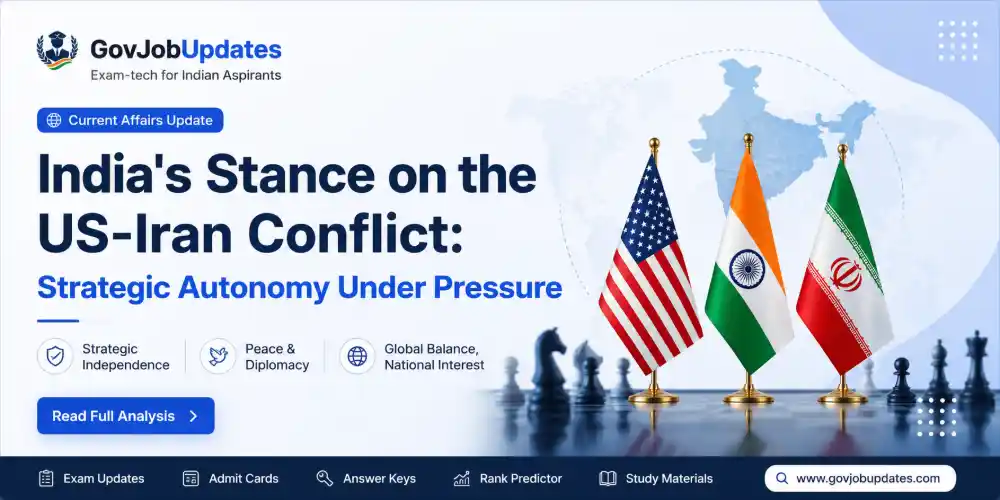
1. What Happened: A Brief Background
In 2026, tensions between the United States, Israel, and Iran escalated into direct military confrontation, including strikes reported on Iranian nuclear and military sites and disruption to shipping and security around the Strait of Hormuz, a critical global oil transit route. A ceasefire understanding was eventually reached in mid-June 2026, but the episode significantly unsettled regional stability and global energy markets.
Throughout the crisis, India avoided taking an explicit side, instead issuing statements calling for restraint, de-escalation, and protection of civilians, while closely monitoring the safety of Indian nationals in the region and the security of its energy supply routes.
2. Why India Chose a Restrained Response
India's caution reflects several overlapping interests. It imports a very large share of its crude oil needs, and much of that oil moves through or near the Strait of Hormuz, so any escalation there threatens fuel prices and energy security directly. At the same time, India maintains strong strategic and defence ties with both the United States and Israel, alongside historic energy and connectivity ties with Iran, most visibly through the Chabahar port project that gives India access to Afghanistan and Central Asia while bypassing Pakistan.
Commentators have pointed out that this balancing act raises a genuine question: does strategic autonomy remain credible when a country avoids commenting on the human cost of a conflict in order to protect its own economic and strategic interests? This tension between principle and pragmatism is exactly the kind of analytical point that mains-level or interview-style questions tend to probe.
3. Why This Matters for India's Foreign Policy Identity
India has historically positioned itself as a voice for the developing world and for international law, going back to its non-aligned movement roots. Critics argue that a muted response during a conflict with serious civilian consequences sits uneasily with that self-image. Supporters counter that quiet diplomacy and neutrality, rather than public posturing, is what allows India to maintain working relationships with all sides and potentially play a constructive role in de-escalation behind the scenes.
4. Static GK Connect for Exams
- Strait of Hormuz: A narrow, strategically vital waterway between Iran and Oman through which a major share of the world's seaborne oil passes.
- Chabahar Port: An Iranian port developed with Indian investment, giving India connectivity to Afghanistan and Central Asia without transiting Pakistan.
- Strategic Autonomy: India's policy of independent decision-making in foreign affairs, evolved from Cold War-era non-alignment.
- Operation Ganga / similar evacuation missions: India has a track record of evacuating its citizens from conflict zones; students should note the general pattern of such missions during regional crises.
- India's energy import dependence: India imports a large majority of its crude oil requirements, making Gulf and West Asian stability a direct national interest.
Frequently Asked Questions (FAQs)
What was India's official stance during the 2026 US-Iran conflict?
India maintained a restrained, largely neutral position, calling for de-escalation and dialogue rather than openly backing either side. This reflected its long-standing strategic autonomy approach, balancing its energy and connectivity interests with Iran against its strategic partnership with the United States and Israel.
Why does the Strait of Hormuz matter to India?
A very large share of India's crude oil imports passes through or near the Strait of Hormuz, so any disruption to shipping in that route directly threatens India's energy security and fuel prices, making stability in the region a core national interest.
What is the significance of the Chabahar port for India-Iran relations?
Chabahar port in Iran gives India an alternative trade and connectivity route to Afghanistan and Central Asia that bypasses Pakistan, making it a key strategic and economic asset in India's relationship with Iran, independent of the broader US-Iran tensions.
Note for candidates: This was a fast-evolving international security situation. Casualty figures, ceasefire terms, and India's official statements should always be cross-checked on the Ministry of External Affairs website before being used in an exam or interview response.
Discussion 0
Join the Discussion
Login to your account to share comments, tips, and engage with other aspirants.