
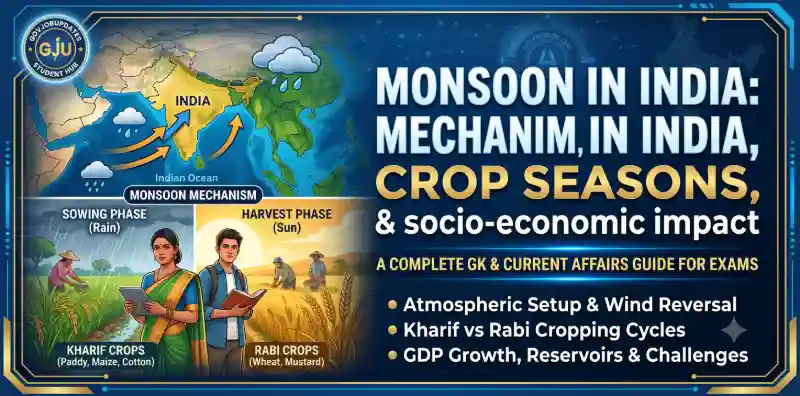
Quick Academic Snapshot
Monsoon denotes a periodic seasonal reversal of winds. In India, it displays a dual identity: the Southwest Monsoon (June to September) providing over 75% of domestic rainfall, and the Northeast Monsoon (October to December) catering primarily to the southeastern coast. With more than half of India's net sown area lacking artificial irrigation, the timing, volume, and geographical distribution of monsoon rains heavily dictate national GDP expansion, food security matrices, inflation indices, and water resource levels.
1. Why Students Must Master the Indian Monsoon System
Every year, central and state examination boards frame numerous analytical questions around the structural behavior of the Indian Monsoon. Whether it is conceptual tracking of atmospheric phenomena in UPSC Mains, statistical identification of crop groups in SSC exams, or evaluating food inflation matrices in Banking interviews, the monsoon system touches multiple disciplines. Aspirants must avoid looking at the monsoon as a simple rainy season and instead break down its meteorological, agricultural, fiscal, and institutional dimensions.
This long-form study guide offers a wide perspective on the Indian Monsoon. It moves past generic descriptions to provide deep conceptual insight into pressure gradients, upper air circulations, seasonal cropping behaviors, reservoir economics, and climate change projections. It is tailored to match active exam patterns while maintaining a supportive, student-friendly tone.
2. Scientific Etymology and Core Concept of Monsoon
The term "Monsoon" is derived from the Arabic word 'Mausim', which translates literally to 'season'. It fundamentally represents a large-scale, periodic seasonal reversal in direction of prevailing regional winds, caused primarily by differential heating and cooling ratios between expansive landmasses and adjacent oceanic water bodies. During the summer, land surfaces heat up significantly faster than water surfaces, creating deep continental thermal depressions that draw in high-moisture sea winds to precipitate inland.
In winter, this system flips completely as the land cools down rapidly compared to the thermal retention of the surrounding oceans, shifting wind trajectories to blow outward from dry continental interiors toward the sea. In India, this large-scale wind shift dominates the entire subcontinent's climate, dividing the calendar year into distinct wet and dry phases.
3. The Intricate Mechanism of the Southwest Monsoon
The summer monsoon, or the Southwest Monsoon, progresses through specialized meteorological phases that students must understand in exact sequential order. Its setup involves complex changes in wind directions, pressure fields, and high-altitude air currents over the Indian Ocean and South Asia:
Differential Heating of Land and Water: Intense summer heating over the extensive landmass of Peninsular India, particularly across the arid Thar Desert and the elevated Tibetan Plateau, creates a massive low-pressure zone. Meanwhile, the surrounding Indian Ocean maintains a comparatively high-pressure profile, setting a strong pressure gradient that pulls winds northward.
Shift of the Inter-Tropical Convergence Zone (ITCZ): In summer, the ITCZ—an equatorial low-pressure belt where trade winds meet—moves northward from its baseline equatorial position to settle over the Indo-Gangetic plains, roughly parallel to 20° to 25° North latitude. This shifts the focus of global moisture convergence directly over northern India.
The Role of Jet Streams: Atmospheric dynamics are strongly governed by high-altitude air currents. The Sub-Tropical Westerly Jet Stream, which flows over Northern India during the winter, must completely withdraw northward beyond the Himalayas. Its departure allows the Tropical Easterly Jet Stream to establish itself over the southern peninsula, triggering the heavy onset of surface-level monsoon winds.
Cross-Equatorial Flow and Coriolis Force: Southeast trade winds originating in the southern hemisphere cross the equator into the northern hemisphere. As they cross, the Earth's rotation exercises the Coriolis Force, deflecting these winds toward the right. This deflection reshapes them into a strong Southwest Monsoon current that sweeps across the Arabian Sea and the Bay of Bengal into India.
4. The Geographical Advance: Two Branches of Southwest Monsoon
Upon striking the southernmost tip of the Indian peninsula, the incoming Southwest Monsoon splits into two primary operational branches due to the land's structural geometry. Both branches distribute rainfall unevenly across different geographic regions of India:
The Arabian Sea Branch: This branch hits the Western Ghats first. As it is forced up the mountain slopes, it releases heavy orographic rainfall along the windward coastal plains of Kerala, Karnataka, and Maharashtra. After crossing the crests, it loses much of its moisture, leaving the eastern Deccan plateau in a prominent rain-shadow zone. A sub-section moves north parallel to the Aravalli Range; because it lacks a high mountain barrier to intercept the clouds, it brings very little rain to Rajasthan.
The Bay of Bengal Branch: This eastern branch travels across the open bay, picking up high levels of moisture before moving toward northeastern India. It strikes the Garo, Khasi, and Jaintia hills, where the funneling shape of the terrain forces the clouds upward, generating extreme rainfall at Mawsynram and Cherrapunji. The remaining flow is blocked by the massive Himalayan range and deflected westward, carrying gradual rainfall up the Indo-Gangetic plains through West Bengal, Bihar, and Uttar Pradesh.
5. Understanding the Retracting Phase: The Northeast Monsoon
By September, the sun's apparent path begins shifting southward, causing the landmass of Northern India to cool rapidly. This temperature drop breaks down the continental low-pressure trough, causing the ITCZ to retreat south toward the equator. As high pressure builds over Northern India, the prevailing winds reverse direction, blowing from the northeast toward the Southwest.
This system is known as the Retreating or Northeast Monsoon, active from October to December. As these winds move over dry land, they remain largely arid across most of India. However, as they cross the Bay of Bengal, they pick up moisture and strike the southeastern coast, bringing vital winter rains to coastal Andhra Pradesh, Rayalaseema, and especially Tamil Nadu, which relies on this phase for its primary water supply.
6. Global Drivers: El Nino, La Nina, and the Indian Ocean Dipole
The Indian Monsoon does not operate in isolation; its performance is heavily influenced by large-scale ocean-atmospheric cycles across the planet. Students must master these connections for modern analytical current affairs questions:
El Nino: This phase involves abnormal warming of surface waters in the central and eastern tropical Pacific Ocean. It disrupts global trade wind patterns, weakening the equatorial easterlies and shifting major rain-bearing clouds away from Asia. Historically, El Nino years frequently coincide with a weakened Southwest Monsoon in India, causing deficit rainfall, late onsets, or severe droughts.
La Nina: The direct opposite of El Nino, characterized by unusual cooling of the eastern Pacific waters. It strengthens the Pacific trade winds, boosting the moisture-carrying capacity of Asian air currents. For India, La Nina years typically bring normal to above-normal monsoon rainfall, resulting in robust crop yields but increasing the risk of widespread flooding.
Indian Ocean Dipole (IOD): Often called the "Indian Nino," the IOD is defined by the temperature difference between the western and eastern sectors of the Indian Ocean. A **Positive IOD** features warmer waters in the western Indian Ocean near Africa, which enhances monsoon wind strength and can counteract the negative impacts of an El Nino. Conversely, a **Negative IOD** brings cooler western waters, which hampers monsoon performance.
7. Major Crop Seasons Linked with the Indian Monsoon
Agriculture is the primary bridge connecting monsoon rains to the Indian economy. The annual farming calendar is explicitly structured around seasonal moisture availability, giving rise to three major crop seasons that are frequently tested in competitive exams:
| Crop Season | Sowing Period | Harvesting Period | Primary Climatic Requirements | Key Exemplary Crops |
|---|---|---|---|---|
| Kharif | June - July (Monsoon Onset) | September - October | High moisture, warm temperatures, heavy initial watering | Rice (Paddy), Maize, Jowar, Bajra, Cotton, Jute, Soyabean, Groundnut |
| Rabi | October - November (Winter Onset) | March - April | Low moisture, cool growing period, bright sunshine for ripening | Wheat, Barley, Mustard, Gram, Peas, Linseed |
| Zaid | March - April (Summer Phase) | May - June | Dry warm weather, continuous long day length, artificial irrigation | Watermelon, Muskmelon, Cucumber, Gourd, Fodder Crops |
The success of the Kharif crop sets the baseline for national agricultural production. Adequate early rain ensures proper seed germination and expands the total area under cultivation. Furthermore, the residual soil moisture left behind by a healthy Southwest Monsoon, combined with the replenishment of groundwater reserves, is vital for sowing Rabi crops like wheat later in the winter.
8. The Structural Socio-Economic Benefits of a Normal Monsoon
A stable, well-distributed monsoon benefits more than just rural communities; it acts as a powerful catalyst across the entire Indian economy through several interconnected sectors:
- **Boosting Rural Consumption and Demand:** Over half of India's population depends directly on agriculture for their livelihood. A successful harvest translates into higher rural incomes, which drives market demand for consumer goods, two-wheelers, tractors, smartphones, and fast-moving consumer goods (FMCG).
- **Controlling Food Inflation:** Steady agricultural output keeps food supply chains stable. Normal rainfall prevents sharp spikes in the prices of essential commodities like pulses, vegetables, and oilseeds, allowing the Reserve Bank of India (RBI) to maintain stable interest rates and favorable monetary policies.
- **Replenishing Hydropower and Water Reserves:** Monsoon rains fill India's major water reservoirs and river basins. This stored water is critical for industrial operations, domestic drinking supply, and generating clean hydropower, which reduces the country's reliance on fossil fuels.
- **Reducing the Fiscal Burden:** When the monsoon fails, the government faces heavy financial strain from funding emergency drought relief, providing crop insurance payouts, and expanding rural employment subsidies. A normal monsoon keeps these emergency expenses low, allowing public funds to be directed toward long-term infrastructure projects.
9. Key Challenges: Monsoon Vulnerabilities and Extreme Weather
Despite its immense benefits, the monsoon system poses serious administrative and economic challenges. Its inherent unpredictable nature often strains regional resources and tests disaster response frameworks:
The Spatial-Temporal Paradox: Monsoon rainfall is rarely distributed evenly. A single monsoon season can cause severe flooding across Assam, Bihar, and West Bengal due to excessive rain, while simultaneously leaving parts of Marathwada, Vidarbha, and southern districts deeply parched. Managing this imbalance requires immense logistical coordination and infrastructure support.
The Long-Term Threat of Climate Change: Modern meteorological records show that global warming is steadily destabilizing the monsoon's predictable behavior. While the total volume of seasonal rainfall remains relatively constant, the number of steady rainy days is decreasing. It is increasingly common for a region to receive its entire monthly quota of rain within a few hours, leading to destructive urban flash floods, severe soil erosion, and disrupted crop lifecycles.
10. Exam-Ready Points for Quick Revision
- **Monsoon Concept:** Represents a periodic seasonal reversal of wind systems driven by differential heating between continental landmasses and surrounding oceans.
- **Southwest Monsoon (June–September):** Driven by the northward movement of the ITCZ, the withdrawal of the Westerly Jet Stream, and the arrival of moisture-laden cross-equatorial winds.
- **Two Key Branches:** The Arabian Sea Branch (striking the Western Ghats) and the Bay of Bengal Branch (funneled by northeastern hills and directed up the Indo-Gangetic plains).
- **Northeast Monsoon (October–December):** A dry continental wind flow that picks up moisture over the Bay of Bengal, delivering vital winter rains to Tamil Nadu and coastal Andhra Pradesh.
- **Global Atmospheric Triggers:** El Nino typically suppresses or weakens Indian monsoon rainfall, whereas La Nina and a Positive Indian Ocean Dipole (IOD) generally boost it.
- **Core Agricultural Cycles:** Kharif crops (Rice, Maize, Cotton) rely directly on summer rain; Rabi crops (Wheat, Mustard) depend on winter cooling and residual soil moisture.
- **Macroeconomic Impact:** Directly influences rural purchasing power, controls primary food inflation, feeds industrial water reserves, and shapes national GDP growth.
11. Final Academic Conclusion
For government job aspirants, understanding the Indian Monsoon requires looking beyond the basic seasonal weather shift. It is a complex interaction of physical geography, global atmospheric cycles, environmental science, and national economics. As climate change alters traditional weather patterns, managing water resources and adapting agricultural practices will remain central to public administration and policy planning.
As you prepare for your exams, focus on connecting these geographic concepts with real-world economic impacts, such as inflation trends, rural development programs, and disaster management initiatives. Keep your core concepts clear, revise the seasonal crop cycles regularly, and stay updated on the latest climate reports from official agencies.
अक्सर पूछे जाने वाले प्रश्न (FAQs)
What is the primary cause of the Indian Monsoon mechanism?
The primary cause of the Indian Monsoon is the differential heating and cooling of the landmass of Peninsular India and the surrounding oceans, which creates distinct pressure gradients leading to seasonal wind reversals.
Which are the prominent crops associated with the Southwest Monsoon?
Major Kharif crops sown during the Southwest Monsoon include Rice (Paddy), Maize, Jowar, Bajra, Cotton, Jute, Groundnut, and Soyabean, which require substantial moisture and heat.
How does El Nino affect the performance of the Indian Monsoon?
El Nino generally causes warming of the central and eastern Pacific Ocean waters, disrupting normal atmospheric currents, which frequently weakens the Indian Southwest Monsoon winds and leads to deficit rainfall or drought-like conditions.
Sources checked
Disclaimer
This article is compiled strictly for educational awareness and exam-preparation guidance. Meteorological patterns, sowing dates, and economic indices change periodically based on real-time climate fluctuations. Candidates are strongly advised to cross-verify current data points from the official websites of the India Meteorological Department (IMD) and relevant ministries.
Discussion 0
Join the Discussion
Login to your account to share comments, tips, and engage with other aspirants.