1. NEET UG 2026: A Quick Recap of How We Got Here
Before diving into the next steps, it helps to understand the timeline of NEET UG 2026, because this year's cycle was different from most previous years. The original NEET UG 2026 examination was scheduled for 3 May 2026. Following widespread reports and allegations of a paper leak, the National Testing Agency cancelled that exam and announced a fresh, re-conducted examination. This re-examination, widely referred to as "Re-NEET 2026," was held on 21 June 2026 across exam centres in India and select international locations.
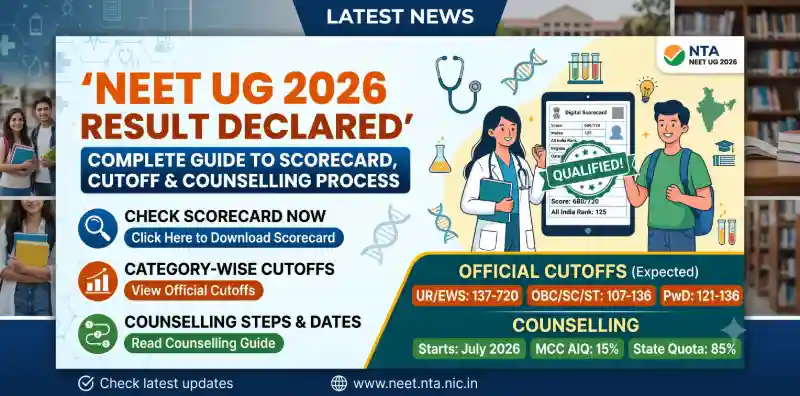
According to multiple education portals and news reports tracking the exam, more than 22 lakh candidates had registered for NEET UG 2026, and close to 20 lakh candidates appeared for the re-examination. After the provisional answer key was released and the objection window closed, the NTA prepared the final answer key and used it to compute the result. The NEET UG 2026 result was subsequently declared on 16 July 2026 on the official website, neet.nta.nic.in.
This background matters because the cancellation and re-conduct pushed the entire admission cycle — result, counselling, and college reporting — later than usual. If you feel that this year's timeline has been unusually stressful and delayed compared to what your seniors experienced, that is a fair observation, and it is important to plan the next few months with that adjusted timeline in mind rather than comparing it to a "normal" year.
2. How to Download Your NEET UG 2026 Scorecard (Step-by-Step)
Your scorecard is the single most important document for the rest of the admission process, so download it carefully and store multiple copies. Follow these steps:
- Step 1: Visit the official NTA NEET website — neet.nta.nic.in. Do not use any other website, app, or link shared on social media, as unofficial sources can carry outdated or incorrect information.
- Step 2: Look for the link that says "NEET (UG) 2026 Result" or "Scorecard" on the homepage or the candidate activity section.
- Step 3: Enter your application number along with your date of birth or password, exactly as used during registration.
- Step 4: Complete any security check (captcha) shown on screen and submit the form.
- Step 5: Your scorecard will appear on the screen. Check every detail carefully — your name, roll number, category, subject-wise marks, and total score.
- Step 6: Download the scorecard as a PDF and take at least two to three printed copies. Also save a digital copy in cloud storage (such as email or Google Drive) so you always have a backup.
If your scorecard shows any discrepancy — a wrong name spelling, incorrect category, or a marks mismatch compared to your response sheet — do not ignore it. Contact the NTA through the official helpline or grievance portal immediately, since corrections closer to counselling deadlines become far harder to process.
3. Understanding Your NEET Scorecard: Marks, Percentile and All India Rank
Many first-time candidates find the scorecard confusing because it shows several numbers at once. Here is what each of them means:
Raw Marks: This is your actual score out of 720, based on the number of correct and incorrect answers as per the marking scheme (+4 for a correct answer, -1 for an incorrect one, in most subjects and years).
Percentile Score: Unlike marks, percentile tells you how you performed relative to every other candidate who appeared in the same exam. A higher percentile means you scored better than a larger proportion of candidates. NEET uses percentile, not raw marks, to determine whether you have crossed the minimum qualifying cutoff for your category.
All India Rank (AIR): This is your overall rank among all candidates who appeared for NEET UG 2026. Your AIR is what is primarily used during All India Quota (AIQ) counselling by the Medical Counselling Committee (MCC).
Category Rank: If you belong to a reserved category (SC, ST, OBC-NCL, EWS, or PwBD), your scorecard will also usually reflect where you stand within your specific category, which becomes relevant for reserved-seat counselling.
It is worth spending ten minutes simply reading through your scorecard slowly and noting down your AIR, category rank, and percentile in a notebook or notes app. You will need to refer back to these numbers repeatedly during counselling.
4. NEET UG 2026 Result Highlights: What Has Been Reported So Far
Based on data reported by NTA and covered widely by education portals following the 16 July 2026 declaration, the broad picture of this year's result is as follows. Please treat the exact figures below as indicative, and always verify the final, official numbers from the NTA notification or press release rather than any secondary source, including this article.
- Close to 20 lakh candidates appeared out of more than 22 lakh registered candidates.
- Reports indicate that more than 11 lakh candidates have qualified NEET UG 2026, putting the overall qualification rate at roughly the mid-50 percent range.
- Reports have highlighted a strong showing by women candidates this year, with female qualification rates reported as slightly higher than male qualification rates.
- Candidates from across states and union territories have featured in the qualified list, and several state-wise toppers have been reported by regional coaching institutes and news outlets.
Because this data is compiled from post-result media coverage rather than a single verified government table, we strongly encourage you to cross-check any specific figure — especially anything related to toppers, exact qualification numbers, or category-wise breakdowns — directly on neet.nta.nic.in before quoting it elsewhere, such as in an interview or a scholarship application.
5. NEET UG 2026 Cutoff: What "Qualifying" Actually Means
One of the most common sources of confusion right after results is the difference between the "qualifying cutoff" and the "admission cutoff." These are not the same thing, and understanding the difference will save you a lot of anxiety.
The qualifying cutoff (usually expressed as a percentile — for example, the 50th percentile for General category, and lower percentiles for reserved categories) is the minimum standard NTA sets to declare you "NEET qualified." Clearing this cutoff makes you eligible to participate in counselling. It does not guarantee you a seat, and it does not tell you which college or course you might get.
The admission cutoff, on the other hand, is the rank or marks at which the last seat was filled in a specific college, course, and category during a specific round of counselling in a previous year. This number changes every year, every round, and every college, based on how many students choose that particular option. Because NEET UG 2026 counselling has not concluded yet, this year's exact admission cutoffs for each college are not available and will only become clear round by round once seat allotment results are published by MCC and the respective state authorities.
If you see any website or social media post claiming to know the "final 2026 cutoff for AIIMS" or similar specific college-wise figures before counselling rounds are actually conducted, treat it with caution. Rely only on official MCC and state counselling authority bulletins for real cutoff data as each round progresses.
6. What Happens Next: Understanding the Counselling Structure
NEET UG counselling in India is not conducted by a single body. It runs through two parallel tracks, and every candidate needs to understand both:
All India Quota (AIQ) — 15% of seats: This portion of seats in every government medical, dental, and select other colleges is counselled centrally by the Medical Counselling Committee (MCC), under the Directorate General of Health Services. MCC also handles admissions to central institutions such as AIIMS, JIPMER, Delhi University colleges, BHU, AMU, and deemed universities across the country.
State Quota — 85% of seats: The remaining seats in government colleges, along with private and management quota seats, are counselled by the respective state's own Directorate of Medical Education or an equivalent state counselling authority. Each state has its own separate registration process, its own eligibility rules (such as domicile requirements), and its own schedule, which usually starts around the same time as or shortly after the AIQ rounds.
This means most candidates will need to register on at least two different portals — the central MCC portal for AIQ seats, and their home state's counselling portal for state quota seats — to maximise their admission chances. Missing your state's separate registration because you assumed MCC registration covers everything is one of the most common and costly mistakes aspirants make every year.
7. Step-by-Step: MCC Counselling Registration Process
While the Medical Counselling Committee had not published the final 2026 schedule at the time of publishing this article, the broad registration process is expected to closely follow the pattern used in previous years. Here is what you should be prepared for:
- Step 1 — Registration: Visit the official MCC website, mcc.nic.in, and register using your NEET roll number, application number, and date of birth to create your counselling login credentials.
- Step 2 — Fee Payment: Pay the prescribed, non-refundable registration or security fee online. The fee amount usually differs slightly by category (General/OBC/EWS versus SC/ST/PwBD), so check the current fee structure on the official bulletin before paying.
- Step 3 — Choice Filling: Once the seat matrix (the official list of colleges, courses, and seats available for that round) is published, log in again to fill and arrange your preferred colleges and courses in order of priority.
- Step 4 — Choice Locking: Before the deadline, lock your final list of choices. Once locked, you typically cannot make further changes for that round, so double-check the order carefully before confirming.
- Step 5 — Seat Allotment Result: MCC releases the seat allotment result on the scheduled date. Log in to check whether you have been allotted a seat, and in which college and course.
- Step 6 — Document Verification and Reporting: If allotted a seat, you must report to the allotted college (or complete online reporting, depending on the round and instructions) within the given window, along with the required original documents, to confirm your admission.
Keep checking mcc.nic.in directly and regularly during this period, since counselling deadlines are strict and rarely extended for individual candidates who miss a step.
8. Documents You Will Need for Counselling
Start organising these documents now, well before your specific counselling round begins, so you are not scrambling at the last minute:
- NEET UG 2026 admit card (original)
- NEET UG 2026 scorecard/rank letter (original and photocopies)
- Class 10 certificate and mark sheet (for date of birth proof)
- Class 12 certificate and mark sheet (for subject and eligibility proof)
- Original and photocopy of a valid photo ID proof (Aadhaar card, passport, or similar)
- Passport-size photographs (the same photograph used during NEET registration, as instructed)
- Category certificate, if applicable (SC/ST/OBC-NCL/EWS), issued by a competent authority within the validity period specified by counselling rules
- PwBD (Persons with Benchmark Disability) certificate, if applicable, from an authorised medical board
- State domicile or residence certificate, if you are applying for state quota counselling in your home state
- Migration certificate and school leaving certificate, if required by your specific counselling authority
Prepare at least four to five self-attested photocopies of every document, along with the originals, since verification is usually done in person at the reporting centre or college, and requirements can vary slightly between MCC and different state authorities.
9. Choice Filling: Practical Tips That Actually Help
Choice filling often decides the difference between a satisfying admission and years of regret, so approach it thoughtfully rather than in a rush.
Research before you fill, not after: Look into a college's infrastructure, faculty strength, hospital attached for clinical training, hostel facilities, and past cutoff trends before you add it to your list. A quick search of the college's NMC (National Medical Commission) recognition status is also worth doing.
Order choices by genuine preference, not just perceived rank of the college: Since seat allotment works on a "best available choice based on your rank" logic, list colleges in the order you would actually be happy to join — not just from "most famous" to "least famous." A college that suits your specific priorities (location, fees, course) may matter more to your years there than name recognition alone.
Add more choices than you think you need: Candidates sometimes fill only 10–15 choices and end up with no allotment despite a reasonable rank, simply because their limited choices were not available in that round. Filling a longer, well-researched list keeps more doors open.
Understand "float" versus "freeze" options carefully: In many rounds, you can choose whether to stay open for an upgrade in later rounds ("float") or lock in your current allotment permanently ("freeze"). Read the specific rules for each round carefully, since choosing the wrong option can mean losing a seat you already had.
Don't rely only on friends' opinions or coaching institute rumours: Every year, unverified cutoff predictions circulate widely on social media and messaging groups. Cross-check anything you hear against official bulletins before making a decision based on it.
10. Common Mistakes Candidates Make After NEET Results
- Missing the state quota registration: Many candidates register only for MCC (AIQ) counselling and forget that state quota seats require a completely separate registration on their state's own portal.
- Not reading the information bulletin fully: Every counselling round has a detailed information bulletin covering fees, eligibility, and deadlines. Skipping it and relying only on summaries from other websites often leads to missed steps.
- Delaying document preparation: Waiting until the reporting deadline to arrange certificates, especially category or domicile certificates that can take time to issue, is a completely avoidable risk.
- Ignoring official communication channels: Important updates are published on mcc.nic.in and respective state counselling websites. Relying only on WhatsApp forwards or unofficial YouTube videos for deadline information can lead to missed windows.
- Making a final decision under panic: If your rank is lower than you hoped, resist the urge to make an irreversible decision (such as permanently opting out of the process) in the first few emotional hours after seeing your result. Take a day, talk to someone you trust, and then decide.
11. If You Did Not Qualify or Your Rank Is Lower Than Expected
If your result was not what you hoped for, it is completely normal to feel disappointed, and it is worth acknowledging that feeling honestly rather than pushing it away. At the same time, this result does not define your entire future, and there are genuine, practical paths forward.
Some options worth exploring with a career counsellor, teacher, or trusted mentor include: a focused, well-planned repeat attempt with a revised strategy rather than simply repeating the same routine; alternative science-based courses such as BSc Nursing, paramedical sciences, biotechnology, or allied health sciences, several of which do not require a NEET qualification depending on the state and institution; or exploring related fields that use your science background differently, such as research, public health, or health administration.
Whatever you decide, avoid making that decision purely out of pressure or comparison with others. Take time to understand your own options clearly, and if the disappointment feels heavier than you can manage on your own, it is genuinely okay to talk to a school counsellor, family member, or mental health professional about how you are feeling.
12. A Quick Checklist for the Coming Weeks
- Download and safely store multiple copies of your NEET UG 2026 scorecard.
- Note down your All India Rank, category rank, and percentile in one place.
- Start gathering and photocopying all required documents now.
- Bookmark mcc.nic.in and your state counselling authority's official website.
- Avoid unofficial cutoff predictions; wait for official seat matrix and allotment data each round.
- Research colleges and courses before choice-filling windows open, not during them.
- Keep your registered mobile number and email active, since counselling updates are often sent there.
Frequently Asked Questions (FAQs)
Where can I download my NEET UG 2026 scorecard?
The NEET UG 2026 scorecard can only be downloaded from the official NTA NEET website, neet.nta.nic.in, using your application number and date of birth or password. Avoid third-party websites or unofficial links, and always cross-check details from the official portal.
When will MCC counselling 2026 registration start?
As of this article's publication, the Medical Counselling Committee (MCC) had not released the final counselling schedule. Registration is generally expected to open within one to two weeks of the result declaration. Candidates should keep checking mcc.nic.in directly for the confirmed dates rather than relying on estimates.
What should I do if I did not qualify NEET UG 2026?
Not qualifying is not the end of the road. Candidates can explore BSc Nursing, paramedical and allied health courses that do not require NEET qualification in some states, consider a focused one-year repeat attempt with a revised study plan, or explore alternative science-based career paths. It is worth speaking with a career counsellor or trusted mentor before deciding the next step.
Sources checked
- National Testing Agency — Official NEET (UG) Portal
- National Testing Agency — Official Website
- Medical Counselling Committee (MCC) — Official Portal
- GovJobUpdates Career Guidance Cell Guidelines
Note: NEET UG 2026 counselling dates, exact cutoff figures, and final qualification statistics were still being updated by official authorities at the time of publishing. Candidates must verify every date and figure directly from neet.nta.nic.in and mcc.nic.in before making any decision.
Discussion 0
Join the Discussion
Login to your account to share comments, tips, and engage with other aspirants.