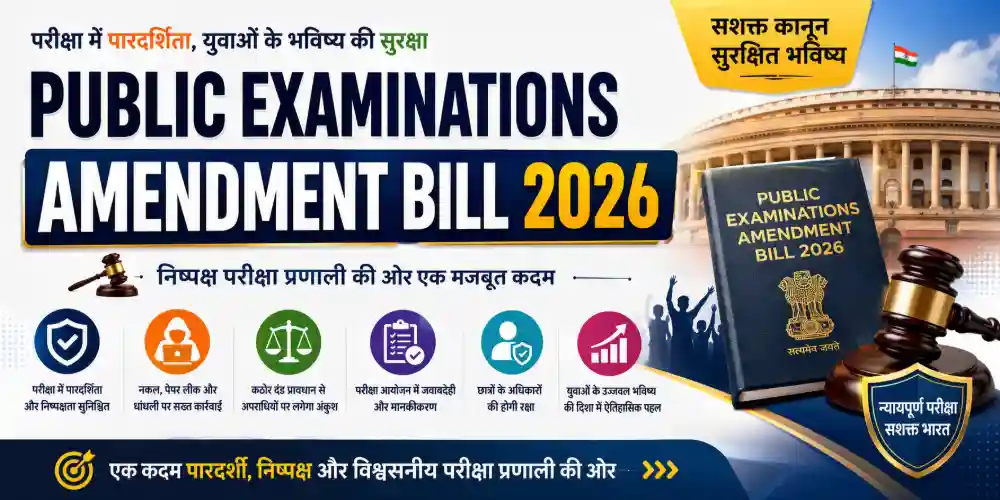
1. Introduction: A Milestone Legislation for Exam Integrity
The Public Examinations (Prevention of Unfair Means) Amendment Bill, 2026, marks a significant step in India's fight against examination malpractices. Passed by the Lok Sabha on July 28, 2026, the Bill strengthens the 2024 Act by introducing stricter penalties, time-bound investigations, and dedicated Fast Track Courts .
This legislation is a direct response to repeated paper leak incidents, including the NEET-UG 2026 controversy, which affected nearly 22 lakh students and triggered nationwide protests . The Bill aims to restore public confidence in India's examination system by ensuring swift justice and imposing severe consequences on offenders and organised syndicates.
2. Why Was the Amendment Bill Introduced?
The 2024 Act was a pioneering law to criminalise paper leaks and unfair means in public examinations. However, the government observed gaps in implementation, particularly regarding delays in investigations and trials .
The NEET-UG 2026 paper leak exposed these weaknesses, leading to political and public outcry. The government introduced this amendment to plug enforcement gaps and strengthen the legal framework, aiming to make India's examination system more transparent and credible .
3. Key Provisions of the Public Examinations Amendment Bill 2026
The Bill introduces sweeping changes to the original Act. Here is a breakdown of the most important provisions:
3.1. Significantly Stricter Punishments
- For Individuals: The minimum jail term for using unfair means is increased from three to five years, and the maximum from five to ten years. The fine ceiling is raised from ₹10 lakh to a staggering ₹50 lakh .
- For Service Providers: Companies hired to conduct exams face a fine of up to ₹5 crore (up from ₹1 crore) and an eight-year debarment from conducting future examinations.
- For Organised Crime: For organised paper leak rackets, the minimum sentence is raised from five to seven years, and the fine can go up to ₹10 crore.
3.2. Establishment of Special Fast Track Courts
One of the most critical changes is the mandate for every state and Union Territory to designate a Sessions Court as a Special Fast Track Court to exclusively try cases under the Act. This aims to avoid the delays common in the regular criminal justice system.
3.3. Mandatory Time-Bound Investigations and Trials
The Bill introduces statutory deadlines to ensure speedy justice :
- Investigation: Must be completed within two months from the date the information is recorded.
- Trial: Must be concluded within three months from the filing of the charge sheet.
- Appeal: Appeals against the court's verdict will be heard by a two-judge High Court bench and disposed of within three months.
3.4. Dedicated Investigative Mechanism
The amendment empowers the Central Government to constitute Special Task Forces for investigating offences, supplementing the work of police and central agencies. This creates a specialised framework to tackle complex, multi-state examination fraud syndicates .
4. What This Law Means for Government Exam Aspirants
For students preparing for UPSC, SSC, Banking, Railways, or NTA exams, this legislation is a major development. It serves as a robust deterrent against organised cheating, aiming to ensure that your hard work is rewarded fairly . The promise of faster trials and harsher punishments should increase the credibility of the examination process.
However, it's also a reminder to stay vigilant. Candidates should rely only on official sources and avoid any person or group promising unfair advantages. The law is designed to protect genuine aspirants from the "exam mafia" that has plagued the system for years .
5. The Parliamentary Debate and What Comes Next
The Bill was passed in the Lok Sabha after a heated debate. While the government hailed it as a "milestone legislation," the Opposition criticised it as an eyewash, arguing that the government had failed to prevent the NEET-UG 2026 leak in the first place . The Bill will now go to the Rajya Sabha for approval .
Frequently Asked Questions (FAQs)
What are the maximum punishment and fine under the Public Examinations Amendment Bill 2026?
Individuals involved in unfair means can face imprisonment of up to 10 years and a fine of up to ₹50 lakh. For organised crime syndicates involved in paper leaks, the fine can go up to ₹10 crore, with a minimum sentence of 7 years.
What is the timeline for investigation and trial under the new anti-paper leak law?
The Bill mandates that investigations be completed within two months from the date the information is recorded. Trials must be concluded within three months from the filing of the charge sheet. Appeals will be heard by a two-judge bench of the High Court and disposed of within three months .
Which examinations are covered under the Public Examinations Act?
The Act covers public examinations conducted by central agencies such as the Union Public Service Commission (UPSC), Staff Selection Commission (SSC), Railway Recruitment Boards, Institute of Banking Personnel Selection (IBPS), and the National Testing Agency (NTA) for higher education admissions .
Discussion 0
Join the Discussion
Login to your account to share comments, tips, and engage with other aspirants.