1. SSC CGL 2026: Where Things Stand Right Now
The Staff Selection Commission released the SSC CGL 2026 notification on 21 May 2026, opening applications for 12,256 tentative vacancies across more than 40 Group B and Group C posts in various central government ministries and departments, including the Income Tax Department, Customs (CBIC), CBI and the Enforcement Directorate. The online application window ran from 21 May to 22 June 2026, with a brief reopening from 23 to 25 June for candidates who missed the first deadline. The fee payment deadline was 23 June 2026, and SSC also opened a correction window from 29 June to 1 July 2026 (some sources list it as 1-3 July) so candidates could fix errors in their submitted forms.
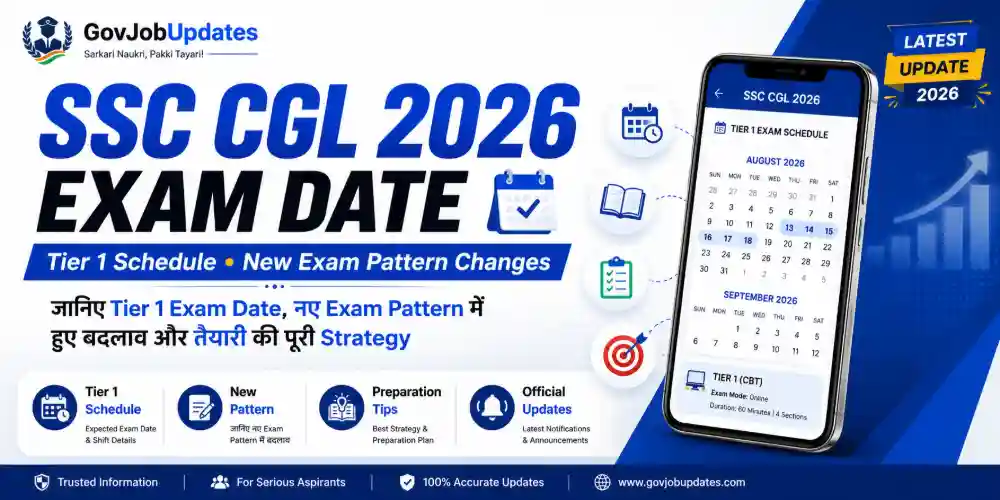
With the application process now complete, all attention has shifted to the SSC CGL Tier 1 exam date. As per the official notification, the Tier 1 Computer-Based Test is scheduled for August-September 2026, and Tier 2 is expected in December 2026. However, as of the end of July 2026, SSC has not yet released the exact date-wise and shift-wise schedule. This detailed calendar is usually published closer to the exam, along with the city intimation slip and the admit card, so candidates should keep checking ssc.gov.in directly rather than relying on guessed dates circulating on social media or coaching WhatsApp groups.
2. The Big Change Everyone Is Talking About: Sectional Timing
If there is one update that has dominated every SSC CGL 2026 discussion this year, it is sectional timing. Until last year, Tier 1 gave you one open 60-minute window to attempt all 100 questions across four sections in whatever order you liked. That flexibility is gone. SSC CGL 2026 now locks each of the four sections — General Intelligence & Reasoning, General Awareness, Quantitative Aptitude, and English Comprehension — into its own fixed 15-minute slot. Once your 15 minutes for a section are up, the screen automatically moves you to the next section, and you cannot go back to attempt leftover questions.
The same principle now applies to SSC CGL Tier 2 Paper 1 as well, where different sections carry their own individual time limits instead of one combined timer. This is a meaningful shift in exam strategy: candidates who used to "borrow" extra time from a strong section (say, finishing Reasoning quickly to spend more time on English) can no longer do that. Every section now has to be attempted and, ideally, finished within its own boundary.
3. Other Notable Changes in the SSC CGL 2026 Notification
Sectional timing isn't the only update this year. A few other changes are worth noting if you're preparing for SSC CGL 2026:
- Paper-III returns for AAO posts: Assistant Audit Officer (Central and State Cadre) and Assistant Accounts Officer (State Cadre) posts are back in the notification, and candidates applying for these posts must clear an additional Tier 2 Paper-III on Finance and Economics, which counts directly toward the final merit.
- Wider eligibility for Statistical Investigator posts: SSC has expanded the eligible degree list for Statistical Investigator Grade-II to include graduates from Artificial Intelligence, Data Science, and Information Technology backgrounds, in addition to the traditional Statistics/Mathematics/Economics streams.
- Live photo capture during application: Candidates now had to take a live photo while filling the form instead of uploading an existing photograph, as part of SSC's tightened identity-verification process.
- Scribe registration through OTR and OTP: Candidates who require a scribe now need to register this requirement through the One Time Registration (OTR) portal and verify it with an OTP, rather than through a manual, offline process.
None of these changes affect the core syllabus — the subjects and topics tested in SSC CGL remain the same as before. What has changed is the exam's structure, timing discipline, and a couple of eligibility and process details.
4. Negative Marking and Marks Distribution: What Stays the Same
It's worth being clear that the marking scheme itself has not changed for SSC CGL 2026. Tier 1 still consists of 100 questions (25 per section) worth 200 marks in total, with 2 marks awarded for every correct answer and 0.50 marks deducted for every incorrect one. In Tier 2 Paper 1, a wrong answer in Section I, Section II, and Module I of Section III still costs 1 mark, while Paper II (Statistics, for JSO posts) and the new Paper III (Finance & Economics, for AAO posts) each carry a deduction of 0.50 marks per wrong answer. There is no negative marking on unattempted questions, and the qualifying-only Computer Knowledge Test and Data Entry Speed Test carry no penalty either.
The reason this matters more this year is simple: with sectional timing in place, careless guessing inside a locked 15-minute window is riskier than before, because you no longer have spare time from another section to recover lost marks. Accuracy inside each section now matters just as much as your overall preparation.
5. What Aspirants Are Saying: The Sectional Timing Debate
Search any SSC-focused forum or subreddit right now, and sectional timing is the topic dominating the conversation. Reactions are genuinely split. A section of aspirants sees it as a fairer system — it forces everyone to attempt every subject instead of skipping a weak section entirely, and it removes the advantage previously enjoyed by candidates who were exceptionally fast in one or two subjects but weak elsewhere. Their argument is that sectional timing rewards balanced, well-rounded preparation over lopsided strength in a favourite subject.
On the other side, many candidates are understandably anxious. The most common worry being raised in study groups and online discussions is what happens if you hit an unusually tough set of questions in your weakest section — under the old pattern you could move on and come back later, but now you're stuck inside that section until the 15-minute timer runs out, with no way to "escape" to an easier part of the paper. There is also a broader undercurrent of frustration about the exact Tier 1 date still not being announced even as August approaches, which is adding to the general uncertainty aspirants are feeling this cycle. If you're seeing similar chatter in your own groups, know that this is a shared, common concern — not a sign that you're under-prepared or behind everyone else.
6. How to Prepare for the New Sectional-Timing Pattern
The good news is that sectional timing is a format change, not a syllabus change — so your existing study material is still relevant. What needs to change is how you practice. A few practical adjustments can make a real difference:
- Switch to sectional mocks immediately: Stop practicing with one open 60-minute timer. Attempt full-length mock tests that replicate the exact 15-minutes-per-section format, so your brain gets used to the hard stop at the end of each section.
- Build a per-section time budget: Within Reasoning and Quantitative Aptitude, work out roughly how much time you can spend per question so you don't run out of time midway through a section. English comprehension passages, in particular, need to be read strategically rather than word-by-word.
- Never sacrifice a section: Since you can no longer skip a weak section and make up marks elsewhere, dedicate specific practice days to your weakest subject rather than repeatedly drilling the one you already enjoy.
- Prioritise accuracy over volume in mocks: With negative marking unchanged, attempting more questions carelessly inside a locked window can hurt your score more than it helps. Track your accuracy percentage per section, not just your total attempts.
- Revisit previous years' papers with a timer: Old SSC CGL PYQs are still useful for content, but re-attempt them section-wise with a 15-minute cap to build genuine familiarity with the new constraint.
- Keep current affairs and static GK on a rolling schedule: Since General Awareness now has a hard 15-minute limit of its own, you either know an answer quickly or you don't — there's little time for second-guessing, so recall speed matters as much as depth.
7. Staying Positive While You Wait for the Official Date
Not knowing the exact exam date yet is genuinely one of the harder parts of this preparation cycle, especially with a pattern change layered on top of the usual pressure. A few small habits can help you stay steady during this waiting period instead of burning out before the exam is even scheduled:
- Treat "August-September" as your real deadline: Rather than waiting for the exact date to start your final revision phase, work backwards from the earliest possible week in August. If the exam ends up being slightly later, you simply get a bit of extra buffer — but you won't be caught underprepared if it isn't.
- Limit how much time you spend on speculation: It's easy to lose hours reading conflicting "expected date" posts online. Bookmark the official SSC website and check it once a day at most; constantly refreshing forums for news that isn't there yet only adds stress without adding preparation.
- Break your revision into weekly, not daily, goals: With sectional timing changing your practice routine, give yourself realistic weekly targets (for example, "complete 4 sectional mocks and review all errors") rather than rigid daily quotas that are easy to fall behind on and feel discouraged about.
- Remember that everyone is adapting to the same change: Sectional timing is new for every single candidate this year, including toppers from previous attempts. Nobody has a built-in advantage from past experience with this exact format — you're not behind, you're simply learning something new alongside 28 lakh other aspirants.
8. Quick Recap: SSC CGL 2026 at a Glance
To summarise where things stand: the SSC CGL 2026 notification was released on 21 May 2026 for 12,256 tentative vacancies, the application process closed by late June 2026, and the Tier 1 exam is expected in August-September 2026 with Tier 2 expected in December 2026 — though SSC has not yet released the exact date-wise schedule. This year's biggest change is sectional timing across Tier 1 (15 minutes per section) and Tier 2 Paper 1, alongside the return of AAO posts with a new Finance & Economics Paper-III. The core syllabus and negative marking scheme remain unchanged. Use the weeks ahead to adapt your mock-test practice to the new format, and keep checking ssc.gov.in directly for the official exam date announcement.
Frequently Asked Questions (FAQs)
Has SSC officially announced the exact SSC CGL 2026 Tier 1 exam date?
As of the writing of this article, SSC has only confirmed that the SSC CGL 2026 Tier 1 exam will be conducted in August-September 2026. The exact date-wise and shift-wise schedule has not been released yet and will be published separately on ssc.gov.in, usually along with or shortly before the admit card.
What is the biggest change in the SSC CGL 2026 exam pattern?
The most talked-about change is the introduction of fixed sectional timing. In Tier 1, each of the four sections (Reasoning, General Awareness, Quantitative Aptitude, English) now gets a locked 15-minute window instead of one open 60-minute timer. Sectional timing has also been introduced in Tier 2 Paper 1, and a new Paper-III (Finance and Economics) has been added for AAO and Assistant Accounts Officer posts.
Is negative marking different in the new SSC CGL 2026 pattern?
No, the negative marking scheme itself has not changed. SSC CGL Tier 1 still carries 2 marks for a correct answer and a deduction of 0.50 marks for each wrong answer. What has changed is that sectional timing now makes guessing riskier, since you cannot borrow time from a stronger section to compensate for wasted attempts in a weaker one.
Discussion 0
Join the Discussion
Login to your account to share comments, tips, and engage with other aspirants.