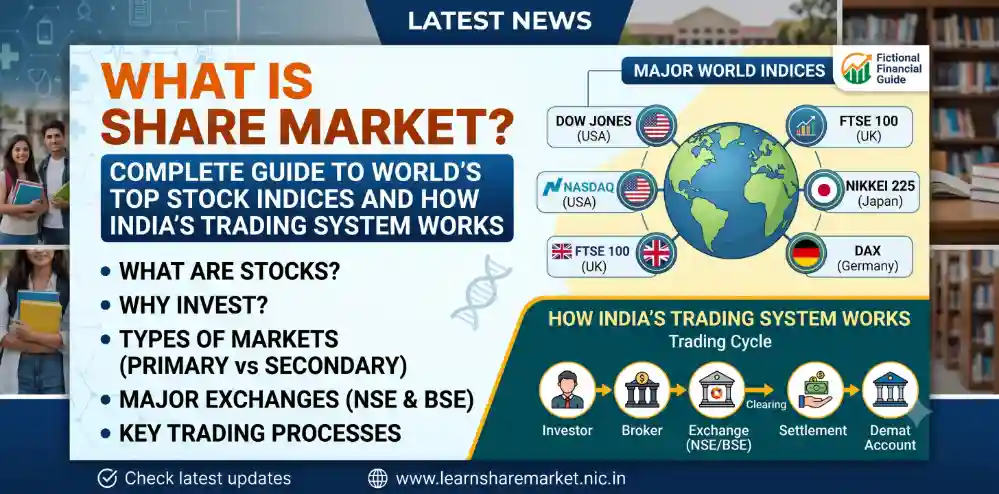
1. What Is Share Market, Really? (Forget the Textbook Definition for a Second)
Imagine your neighbourhood has one incredibly popular samosa shop. The owner wants to open five more branches across the city but doesn't have enough money saved up. So she makes an offer to fifty of her regular customers: "Give me some money now, and in return, I'll give each of you a small ownership slip in my shop. As the shop grows and earns more profit, your slip becomes more valuable. If the shop struggles, your slip loses value too. And whenever you want, you can sell your slip to someone else who believes in the shop."
That, in its simplest form, is exactly what a share is — a small slice of ownership in a company. The "share market" is nothing more than the giant, organised, and heavily regulated version of that samosa shop deal, except instead of one shop and fifty neighbours, it involves thousands of companies and millions of people across the world, all buying and selling ownership slips (shares) in real time.
When people say "share market" or "stock market," they are talking about this entire ecosystem: the companies that offer ownership to the public, the millions of individuals and institutions who buy and sell that ownership, the exchanges where this buying and selling physically happens, and the regulators who make sure nobody cheats anybody in the process.
2. A Short, Surprising History of How This All Began
The idea of a share market is centuries old, and it was born out of a very practical problem: risk. In the early 1600s, European trading companies wanted to send ships to Asia to trade in spices, silk, and other goods. A single voyage was hugely expensive and hugely risky — pirates, storms, and shipwrecks could wipe out an entire investment overnight. So instead of one wealthy merchant funding an entire ship alone, the Dutch East India Company came up with an idea: let many people each contribute a smaller amount, and in return, give each of them a proportional share of whatever profit the voyage brought back.
This single idea — spreading risk by dividing ownership into tradeable pieces — is widely credited as the birth of the modern share market, and it eventually led to the creation of the Amsterdam Stock Exchange, often considered the world's first formal stock exchange. From there, the concept spread to London, New York, and eventually to almost every major economy on earth, including India, where the Bombay Stock Exchange would go on to become one of Asia's oldest exchanges.
What's worth appreciating here is that the fundamental logic has not changed in four hundred years. Whether it was a 17th-century spice voyage or a 21st-century technology company, the share market still exists for exactly the same reason: to let big ideas get funded by many small contributions, while spreading the risk and reward across everyone involved.
3. How the Share Market Actually Works, Step by Step
To really understand the machinery, it helps to separate the share market into two connected worlds: the primary market and the secondary market.
The Primary Market — Where Shares Are Born: This is where a company sells shares to the public for the very first time, through what is called an Initial Public Offering, or IPO. A private company that wants to raise money from the public files detailed documents with the regulator, sets a price band for its shares, and invites investors to apply. Once the IPO closes and shares are allotted, the company gets the money it needed, and investors get official ownership certificates in electronic form.
The Secondary Market — Where Shares Change Hands: Once a company's shares are listed on a stock exchange, that is where the real, everyday "share market" action happens. Investors who already own shares can sell them to other investors who want to buy, all without the company itself being directly involved in that specific trade. This is exactly like our samosa shop example — once you own a slip, you can sell it to your friend, and the shop owner has nothing to do with that particular transaction.
Prices in the secondary market move constantly because of one simple force: demand and supply. If more people want to buy a company's shares than sell them at a given price, the price rises. If more people want to sell than buy, the price falls. Every single number you see flashing red or green on a stock market app is simply this tug-of-war, playing out thousands of times a second, across thousands of companies.
4. What Exactly Is a Stock Market "Index"? (The Health Report Card Analogy)
If you have ever gone for an annual health check-up, you know the doctor doesn't measure every single cell in your body. Instead, they check a handful of representative indicators — blood pressure, sugar levels, cholesterol — and use those to judge your overall health. A stock market index works exactly the same way.
An index is a carefully chosen basket of representative companies from a stock exchange, and its value moves up or down based on the combined performance of those companies. Instead of tracking thousands of individual stocks one by one, investors, economists, and journalists can simply look at "the index" to get an instant sense of whether the broader market — and by extension, often the broader economy — is doing well or struggling.
This is precisely why every news bulletin around the world leads with "the market closed higher/lower today" — they are really talking about one or two major indices, using them as a proxy report card for the health of an entire national economy.
5. The World's Top Most-Watched Stock Market Indices
Different countries have their own flagship indices, and together, these form the pulse that global investors, economists, and even governments track every single day. Here are the ones that matter most on the world stage.
S&P 500 (United States)
Widely considered the single most important stock index in the world, the S&P 500 tracks 500 of the largest publicly listed companies in the United States, spanning technology, healthcare, finance, energy, and virtually every other sector. Because of the sheer size and diversity of the American economy, and because so much global capital flows through Wall Street, the S&P 500 is often treated as a barometer not just for the US, but for the health of the global economy itself.
Dow Jones Industrial Average (United States)
One of the oldest stock indices in the world, the Dow Jones tracks just 30 large, well-established American companies across different industries. It carries enormous historical and psychological weight — when people casually say "the market fell 500 points" in American news, they are very often talking about the Dow.
Nasdaq Composite / Nasdaq 100 (United States)
The Nasdaq indices are heavily weighted toward technology and growth companies, making them the index of choice for anyone tracking the world's biggest software, internet, and semiconductor businesses. When people talk about "tech stocks rallying" or "tech stocks crashing," the Nasdaq is usually the index doing the talking.
FTSE 100 (United Kingdom)
Short for the "Financial Times Stock Exchange 100 Index," the FTSE 100 tracks the 100 largest companies listed on the London Stock Exchange and remains the primary benchmark for the health of the UK's corporate economy.
DAX 40 (Germany)
Germany's flagship index tracks 40 major German companies and is closely watched as a proxy for the strength of Europe's largest industrial economy, given Germany's outsized role in manufacturing, automobiles, and engineering.
Nikkei 225 (Japan)
Asia's most historically significant index, the Nikkei 225 tracks 225 major companies listed on the Tokyo Stock Exchange and serves as the primary gauge of Japan's economic health, a country whose electronics, automotive, and robotics industries remain globally influential.
Hang Seng Index (Hong Kong)
The Hang Seng tracks major companies listed in Hong Kong and is often used by global investors as a window into broader Chinese and East Asian economic sentiment, given Hong Kong's role as a financial gateway to mainland China.
Shanghai Composite / CSI 300 (China)
These indices track companies listed on mainland Chinese exchanges and are closely watched given China's position as the world's second-largest economy and one of its most influential manufacturing and export powerhouses.
KOSPI (South Korea)
South Korea's benchmark index has grown increasingly influential in recent years, reflecting the country's dominance in semiconductors, electronics, and shipbuilding — sectors that ripple across global supply chains.
While specific point values and daily percentage movements of these indices change constantly and should always be checked live on a financial data platform rather than any static article, the identity and importance of these flagship indices themselves has remained fairly consistent for decades, which is exactly why they continue to headline financial news around the world.
6. India's Own Share Market System, Explained From the Ground Up
India runs one of the largest, most technologically advanced share market systems in the world, built on a small set of institutions that work together like the different departments of a well-run organisation. Here is how each piece fits into the whole.
Bombay Stock Exchange (BSE)
Established in 1875, the BSE is not just India's oldest stock exchange — it is widely recognised as the oldest stock exchange in the whole of Asia. It began under a literal banyan tree in Mumbai, where a small group of stockbrokers used to gather, and has since grown into one of the world's largest exchanges by the number of listed companies.
National Stock Exchange (NSE)
Set up in 1992, the NSE was India's answer to modernising its share market with fully electronic, screen-based trading, replacing the older system of brokers physically shouting orders across a trading floor. Today, the NSE is the larger of India's two major exchanges by trading volume and is where the majority of daily share market activity in India actually takes place.
Securities and Exchange Board of India (SEBI)
If BSE and NSE are the marketplaces, SEBI is the referee making sure everyone plays fair. Set up to regulate India's securities market, SEBI's job includes protecting investors from fraud, ensuring companies disclose information honestly, regulating stockbrokers and intermediaries, and stepping in whenever manipulative or unfair practices are suspected. Every legitimate broker, exchange, and mutual fund operating in India functions under SEBI's rulebook.
Sensex — The BSE's Flagship Index
Short for the "Sensitive Index," the Sensex tracks 30 of the largest, most actively traded, and financially sound companies listed on the BSE. It is India's oldest stock market index and remains one of the two numbers most Indians associate with "the market" doing well or badly.
Nifty 50 — The NSE's Flagship Index
The Nifty 50 tracks 50 large companies listed on the NSE across a wide spread of sectors, making it slightly broader in coverage than the Sensex. Alongside Nifty 50, the NSE also runs several other well-followed indices such as Nifty Bank (tracking major banking stocks), Nifty Next 50, Nifty Midcap, and Nifty IT, each offering a more specific lens into a particular slice of the Indian economy.
Depositories — NSDL and CDSL
Shares in India today exist purely in electronic form, and it is the depositories — the National Securities Depository Limited (NSDL) and the Central Depository Services Limited (CDSL) — that actually hold and safeguard this electronic record of who owns what. Your Demat account, discussed in the next section, is essentially your personal locker within one of these two depositories.
7. How Buying and Selling a Share Actually Works in India (Step by Step)
Here is the practical journey a single trade goes through, from the moment you decide to buy a share to the moment it actually belongs to you.
- Step 1 — Open a Demat and Trading Account: A Demat account holds your shares electronically, similar to how a bank account holds your money. A trading account is what you actually use to place buy and sell orders. Both are opened through a SEBI-registered stockbroker, usually with your PAN card, address proof, and bank account details.
- Step 2 — Place an Order: Using your broker's app or website, you place an order to buy or sell a specific number of shares of a specific company, at either the current market price or a price you specify.
- Step 3 — Order Matching on the Exchange: Your order travels to the exchange (NSE or BSE), where a computerised matching system pairs your buy order with someone else's sell order (or vice versa) at a mutually acceptable price.
- Step 4 — Clearing: Once matched, the trade goes to a clearing corporation — such as NSE Clearing Limited or Indian Clearing Corporation Limited — which verifies the trade and calculates exactly what each party owes and is owed, netting out thousands of trades to keep the system efficient.
- Step 5 — Settlement: This is the final step where money actually moves from the buyer's account and shares actually move into the buyer's Demat account, while the seller receives payment and loses ownership of the shares. India completed its shift to a T+1 settlement cycle in 2023, meaning a trade executed today is fully settled by the next working day — a pace among the fastest in the world. In recent years, SEBI has also been rolling out an optional, same-day T+0 settlement facility for a growing list of large stocks, moving India further toward near-instant settlement, though this remains a phased, evolving rollout rather than the universal standard just yet.
From your perspective as an investor, all of this clearing and settlement machinery works invisibly in the background. What you experience is far simpler: you place an order, and within moments, either the shares appear in your Demat account or the sale proceeds appear in your linked bank account.
8. The IPO Journey: How a Company Enters the Share Market
Every listed company in India once went through the same doorway: an Initial Public Offering. The process typically follows this path: the company first files a draft prospectus with SEBI, disclosing its financials, business model, and how it intends to use the money raised. Once approved, the company announces a price band and opens the IPO for a few days, during which retail investors, institutions, and high-net-worth individuals can apply for shares.
After the subscription window closes, shares are allotted based on demand, and the company gets listed on the stock exchange — meaning its shares can now be freely bought and sold in the secondary market by the general public. In recent years, SEBI has worked to compress this timeline considerably, so that listing now typically happens only a handful of days after the subscription period ends, a significant improvement over the much longer waiting periods of the past.
9. Why the Share Market Matters — Beyond the Numbers on a Screen
It is tempting to think of the share market as something abstract that only matters to traders and business news anchors. In reality, its impact reaches far further into everyday life than most people realise.
For companies, the share market is often the most efficient way to raise large amounts of capital to build factories, hire people, and expand operations — capital that fuels job creation and economic growth. For everyday savers, it offers a way to potentially grow wealth over the long term, whether directly through individual shares or indirectly through mutual funds, pension funds, and insurance products, most of which invest a portion of your money in the share market on your behalf, often without you even realising it. For governments and policymakers, the movement of major indices offers a real-time pulse on business confidence and economic sentiment, feeding into decisions on interest rates, taxation, and economic policy.
In short, even if you have never personally bought a single share, the share market is almost certainly already touching your life — through your provident fund, your insurance policy, or the economic environment your job exists within.
10. Common Myths About the Share Market, Cleared Up
- "Share market is basically gambling." Gambling typically involves pure chance with no underlying value being created. Investing in shares means owning a genuine piece of a real business, whose value is tied to that business's actual performance over time — though short-term price swings can certainly feel unpredictable, and poorly researched, emotion-driven trading can indeed carry gambling-like risk.
- "You need to be rich to start." Indian exchanges allow the purchase of even a single share, and many well-known companies trade at prices well within reach of a student or first-time earner.
- "The market only benefits big investors." While institutional investors do move large sums, SEBI's regulatory framework, transparent pricing, and equal access to exchange platforms mean the same live price is available to a retail investor buying ten shares as it is to a large fund buying ten thousand.
- "You can get rich quickly by 'catching the right tip.'" This is one of the most financially damaging myths in circulation. Genuine wealth creation through the share market has historically rewarded patience, research, and long time horizons far more reliably than chasing short-term tips or rumours.
11. A Few Practical Starting Points for Absolute Beginners
If this article has made you curious about the share market rather than intimidated by it, here are a few sensible, low-risk starting points to build genuine understanding before committing real money:
- Spend time simply reading company financial statements and business news before opening any trading account, so the terminology stops feeling foreign.
- Track a few major indices — Sensex, Nifty 50, and one or two global indices like the S&P 500 — over a few weeks just to see how and why they move.
- Only ever open Demat and trading accounts through SEBI-registered brokers, and verify registration details on SEBI's official website before sharing any documents or money.
- Be deeply skeptical of any social media account, WhatsApp group, or unsolicited call promising "guaranteed returns" or "sure-shot tips" — these are consistently among the most common ways ordinary investors lose money.
- Consider starting your learning journey with well-established mutual funds or index funds before attempting individual stock picking, since these are professionally managed and inherently more diversified.
A quick note before you go further: This article is written purely for general educational understanding of how the share market functions. It is not financial or investment advice, and specific decisions about where, when, or how much to invest should always be made after your own research or in consultation with a qualified, SEBI-registered financial advisor, since individual financial situations, goals, and risk tolerance vary widely from person to person.
Frequently Asked Questions (FAQs)
What is the basic difference between the share market and a stock exchange?
The share market is the broader concept — the entire system through which ownership of companies is bought and sold. A stock exchange, like the BSE or NSE, is the actual regulated marketplace or platform where that buying and selling physically takes place. In other words, the stock exchange is the venue; the share market is the whole activity happening inside it.
Is Sensex or Nifty a better indicator of the Indian market?
Neither is strictly "better" — they measure very similar things using slightly different baskets. Sensex tracks 30 large, well-established companies listed on the BSE, while Nifty 50 tracks 50 large companies listed on the NSE across more sectors. In practice, both tend to move in the same direction most of the time, and most investors and analysts track both together for a fuller picture.
Do I need a lot of money to start investing in the share market in India?
No. Indian stock exchanges allow you to buy even a single share of most listed companies, and many companies have share prices that are quite affordable. What matters far more than the amount you start with is understanding the basics first, opening accounts only through SEBI-registered brokers, and avoiding decisions based on tips or rumours rather than research.
Sources checked
- Securities and Exchange Board of India (SEBI) — Official Website
- Bombay Stock Exchange (BSE) — Official Website
- National Stock Exchange of India (NSE) — Official Website
- GovJobUpdates Career Guidance Cell Guidelines
Note: This article explains general concepts, structures, and processes of the share market. It is not investment advice. Index values, settlement rules, and specific regulatory details evolve over time — always verify current figures and rules on the official SEBI, BSE, and NSE websites before making any financial decision.
Discussion 0
Join the Discussion
Login to your account to share comments, tips, and engage with other aspirants.